Integration of Tribals
Published on 29 Sep 2025
Tribes were one of the communities whose lives were completely overturned as a result of colonial contact and thus presented one of the biggest challenges in terms of integration into mainstream India.
Problems faced by the Tribals
Land alienation: Many tribal lands were taken over by non-tribal individuals, often through illegal means or coercion. This resulted in the displacement of tribal populations from their traditional homelands.
Example: Bauxite mining in Niyamgiri hills of Odisha impacted Dongria Khond tribe.
Exploitation: Tribal communities were often economically exploited and marginalized. They faced low wages, bonded labour, and unfair practices in the labour market, which perpetuated their poverty.
Example: Bonded labour involving Sahariya tribes of Rajasthan, who have traditionally worked in stone quarries and mines.
Restrictive Forest laws: Tribal use of forests was forbidden by colonial government to facilitate commercial exploitation.
Example: Traditional Jhum cultivation was banned under Indian Forest acts
Cultural Erosion: The process of integration sometimes led to the erosion of tribal cultures and traditions. Assimilation into mainstream society and exposure to outside influences posed a threat to indigenous languages, customs, and ways of life.
Example: Decline of Gondi language due to adoption of mainstream languages.
Displacement due to Development Projects: Many tribal communities were displaced from their ancestral lands due to large-scale development projects such as dams, mining, and infrastructure development.
Example: Displacement of Bhil tribes due to Narmada valley project.
Lack of Political Representation: Tribal communities often lacked adequate political representation, making it challenging for them to voice their concerns and protect their interests in the political arena.
India’s Tribal Policy
Major Approaches
Isolationist Approach: which was to leave the tribes in isolation without interfering in their traditional way of life.
Example: In some north-eastern states like Arunachal Pradesh, Nagaland, and Mizoram, the ILP system restricts the entry of non-tribal and outsiders into tribal areas.
Assimilationist Approach: This approach aimed to integrate tribal communities into mainstream society by encouraging them to adopt mainstream customs, languages, and practices. This has resulted in erosion of tribal cultural identity.
Example: Eklavya model residential schools for tribal students.
Integrationist Approach: It sought to make the tribes an integral part of Indian society while maintaining their distinct identity and culture. This took the middle path between isolationist and assimilationist approach.
Example: Forest Rights Act, 2006 recognizes rights of tribals over forest land.
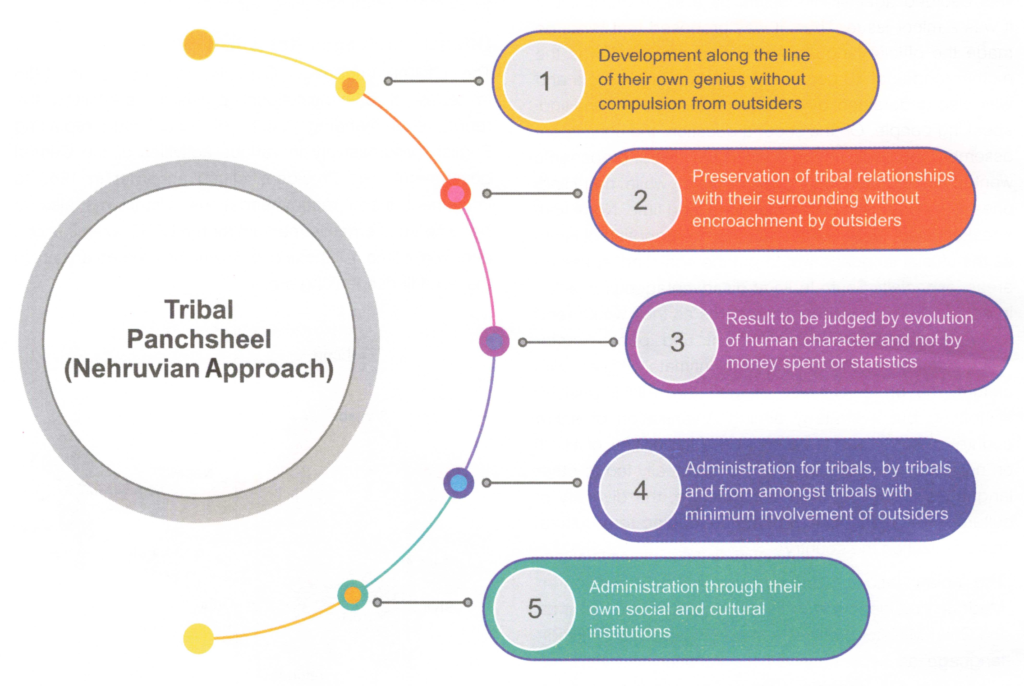
Constitutional safeguards provided to Tribals
Article 46: It directs the state to promote the educational and economic interests of Scheduled Tribes, Scheduled Castes, and other weaker sections.
Article 244: Administration of Scheduled and Tribal areas
Schedule V: For administration of scheduled areas in 10 states with tribes. It empowers the Governor of the state to make regulations for the peace and good governance of these areas.
Schedule VI: For administration of tribal areas in 4 North-eastern states (Assam, Meghalaya, Manipur, Tripura). It has increased autonomy with mandatory requirement for constitution of autonomous districts.
Article 330 and 332: Provides for the reservation of seats for Scheduled Tribes in the Lok Sabha and state legislative assemblies respectively.
Article 335: ensures that the claims of Scheduled Castes, Scheduled Tribes to services and posts in the Indian Government are taken into consideration while formulating policies and making appointments.
Article 338A: Provision for constitution of National Commission for Scheduled Tribes (NCST) tasked with overseeing the rights, welfare, and development of India’s Scheduled Tribes.
Tags:
History & Culture
Keywords:
Integration of Tribals
Problems faced by the Tribals
Land alienation
Niyamgiri hills
Dongria Khond tribe
Sahariya tribes
Jhum
Cultural Erosion
Gondi language
Bhil tribes
displacement
India’s Tribal Policy
Isolationist Approach
Assimilationist Approach
Integrationist Approach
Eklavya model residential schools
inner line permit
ILP
Forest Rights Act 2006
Tribal panchsheel
article 46
article 244
article 330
article 332
article 335
article 338A
schedule 5
schedule 6
Nat
Syllabus:
General Studies Paper 1
Topics:
Post-Independence Consolidation
Related Articles
Backgrounder
HYPOTHETICAL IMPACTS ON MODERN INDIAN HISTORY IF KEY EVENTS DID NOT HAPPEN
Gandhism vs. Moderates
Satyagrahis vs. Revolutionaries
Moderates vs. Extremists
Sardar Vallabhai Patel and Jawaharlal Nehru
Gandhi and Rabindranath Tagore
Gandhi and Bhagat Singh
Gandhi and Subhash Chandra Bose
Gandhi and Ambedkar
Role of Foreigners in Indian Freedom Struggle