Secondary Pollutant
Published on 12 Nov 2025
A recent study from the Centre for Research on Energy and Clean Air (CREA) reveals that secondary pollutants are responsible for nearly one-third of India's fine particulate matter (PM2.5) pollution.
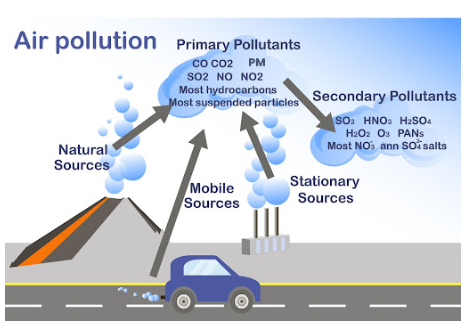
Primary pollutants are released directly from sources like cars and factories.
When these pollutants rise into the atmosphere and react with other gases and water vapor, they form more complex and harmful particles known as secondary pollutants.
The study identifies ammonium sulphate, which forms from the reaction between sulphur dioxide (from coal plants) and ammonia, as a major secondary pollutant.
This one compound accounts for about 34% of India's PM2.5.
The primary source of the pollution-causing sulphur dioxide is coal-fired power plants.
Although it is mandatory for these plants to install flue gas desulphurisation (FGD) systems to clean their emissions, only about 8% of Indian plants have done so.
Keywords:
Secondary Pollutant
Air pollution
Centre for Research on Energy and Clean Air
CREA
particulate matter
PM2.5
ammonium sulphate
coal-fired power plants
flue gas desulphurisation
FGD
Prelims Current Affairs
Brown Trout
Bonnet Macaques
New Aspergillus Species Discovered in Western Ghats
Mains Current Affairs
Ragging in Campus
Time Use Survey 2024
Amir Khusrau and Persian Influence in Indian Culture