Russell’s viper
Published on 16 Oct 2025
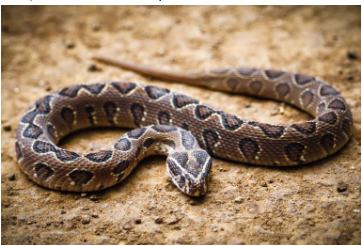
Recent research has revealed innovative “venom maps” that predict the venom characteristics of Russell’s viper (Daboia russelii), a highly dangerous snake prevalent in India.
The toxic effects of a snake's venom are caused by concentrations of enzymes, which are influenced by factors, such as climate and availability of prey.
Temperature and rainfall were found to partly explain the region-to-region variation in snake-venom composition.
The breakdown of proteins, or "protease activity", was found to be higher among snakes in drier regions of India, and using this data, the team created a map of expected venom types of Russell's vipers across its range in India.
The snake is named after Patrick Russell, 18th century British surgeon and naturalist who worked in India and is considered the "Father of Indian Ophiology (the branch of zoology that deals with snakes)”
Russell's Viper is among the "Big Four" snakes of India, responsible for the majority of snakebite fatalities in the country, that includes the Indian Cobra, Common Krait, and Saw-scaled Viper.

Keywords:
Russell’s viper
Snake
Species in news
Biodiversity
Patrick Russell
Big Four snakes
Prelims Current Affairs
Brown Trout
Bonnet Macaques
New Aspergillus Species Discovered in Western Ghats
Mains Current Affairs
Ragging in Campus
Time Use Survey 2024
Amir Khusrau and Persian Influence in Indian Culture