Central Bureau of Investigation
Published on 28 Jan 2025
Central Bureau of Investigation (CBI)
The Central Bureau of Investigation, established in 1963 based on the Santhanam committee recommendation, is the premier investigating agency of India, operating under the jurisdiction of the Ministry of Personnel. It derives its powers to investigate from the Delhi Special Police Establishment Act, 1946.
Functions of CBI
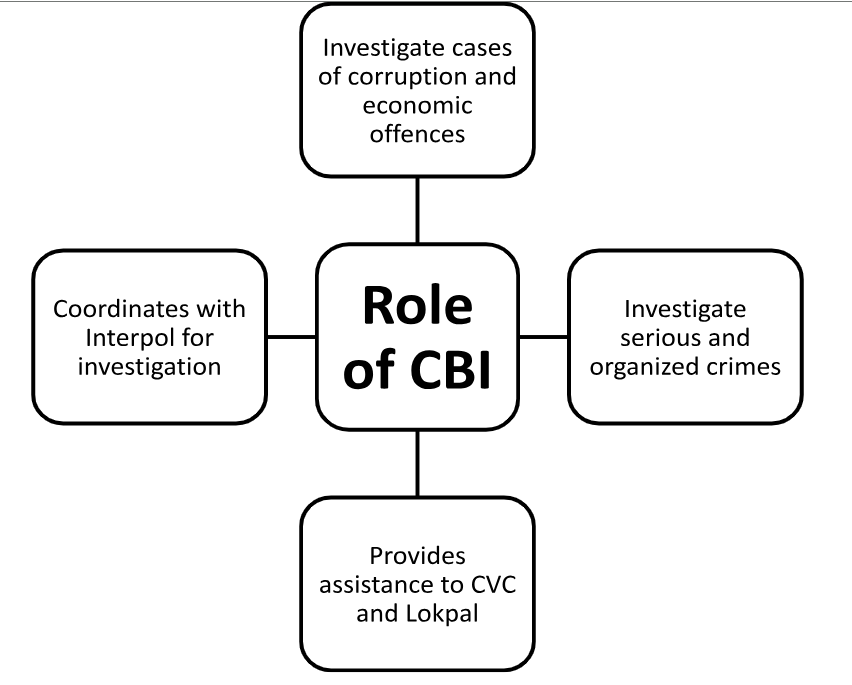
Issues associated with the office of CBI
Political interference: The CBI has been used by the government as instruments to intimidate opposition and critics with the Supreme Court referring to the body as a caged parrot.
Example: Piecemeal extension of CBI directors tenure seen recently showcase increased political interference.
Decline in efficiency: Increase in pendency of cases and decline in conviction rates and indicated the downward trend in CBI’s performance.
Example: Nearly 6800 corruption cases probed by CBI are presently pending. (CVC)
Lack of support from state government: Many state governments view CBI as the agent of the central government and try to reduce their influence in the state by withdrawing general consent.
Example: Recently, states like West Bengal, Kerala, Punjab, Rajasthan etc. withdrew general consent granted to CBI
Shortage of resources: The institution lacks a shortage of modern equipment and skilled manpower which cause overstress among employees and result in unnecessary delay.
Example: In 2020, the Parliamentary panel raised concern regarding 1300 vacant posts in CBI. It depends of MHA for its staff requirements.
Lack of credibility: In recent years, CBI has lost social legitimacy and public trust due to corruption scandals and inefficiencies.
Example: Investigations involving officers at the joint secretary level or above require prior consent from the government before initiation.
Non-statutory body: This limits the power of the institution to probe anyone on its own. Sanction must be obtained from higher authorities for prosecuting Ministers, MLA’s and public servants.
Example: The CVC annual report mentions CBI awaiting for sanctions in 272 cases against public servants.
Lacking accountability: CBI is exempted from the provisions of the Right to Information Act, thus, lacking public accountability.
Overlapping functions: This overlap often occurs in the investigation of certain crimes, where state police agencies and specialized investigative units might handle similar cases.
Example: Both CBI and NIA in money laundering cases
Way Forward
Delink CBI from the control of government: This will facilitate more autonomy in their functioning and enhance credibility within the public.
Separate statute for CBI: A single legislation covering all the powers, limitations and appointment process related to CBI.
Increase resources at disposal: The 24th report of the Parliamentary Standing Committee has recommended increasing the human and financial resources available to the CBI to improve their efficiency.
FBI model of accountability: US has a clear-cut approach of delineating national security issues from law and order issues unlike in India where everything related to internal security is still legally in the domain of the states and rarely with the Centre.
The Central Bureau of Investigation has been one of the most reputed institutions in the country whose role in maintaining law and order is unmatched. Considering their relevance, the power of the institution should be widened to make them function more effectively.
Tags:
Polity
Keywords:
Non constitutional bodies
CBI
Statutory bodies
Syllabus:
General Studies Paper 2
Topics:
Governance and Transparency
Related Articles
Backgrounder
ELECTIONS - Types of elections
Terrorism in Kashmir
NORTH EAST INSURGENCY
MISSION KARMAYOGI
Civil Service Reforms and lateral entry
ROLE OF CIVIL SERVICE IN DEMOCRACY
SEVOTTAM MODEL
CITIZENS CHARTER
E-GOVERNANCE
CENTRALISED PUBLIC GRIEVANCE REDRESS AND MONITORING SYSTEM (CPGRAMS)