CITIZENS CHARTER
Published on 31 Jan 2025
Citizen’s Charter is a document of commitments made by a government organization to the citizens/client groups concerning the services/schemes being provided to them or to be provided to them. Citizen Charter is an effective tool to ensure three fundamental aspects; transparency, accountability, and good governance. It empowers the citizens to press the committed standards of service.

Objectives of Citizens Charter
Standards: The Charter must clearly outline prerequisites for service provision, ensuring clients know what to expect, with requirements being specific, measurable, accurate, timely, and relevant.
Transparency and Openness: Charters must comprehensively outline expected service levels, quality, redressal channels clearly and understandably with timely information.
Effective Communication: In order to establish service standards and evaluate the calibre of service delivery, there should be routine and systematic communication with service consumers.
Principles of Citizens Charter
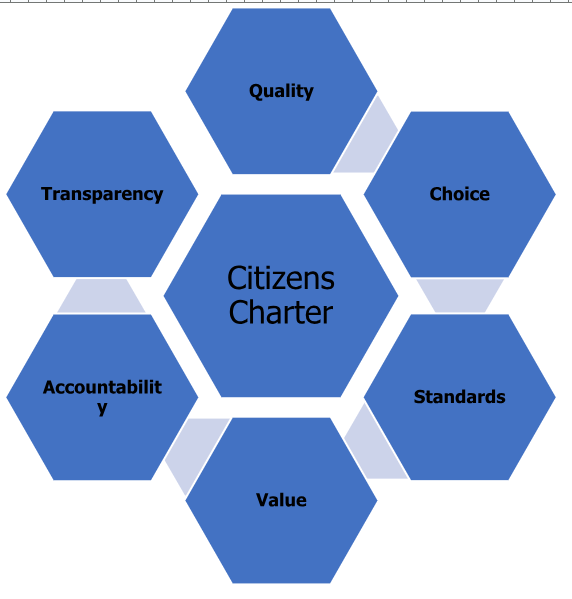
Benefits of Citizens Charter
Service Quality Enhancement: Citizens charter sets standards for service delivery, ensuring that citizens receive high-quality services within specified timeframes.
Example: Citizens' Charter for PMJDY outlines the standards for opening bank accounts, issuing RuPay cards etc., thereby focusing on improving the efficiency and accessibility of financial services.
Citizen-Centric Approach: It ensures that services are designed and delivered based on the needs and expectations of the public, making them more user-friendly and effective.
Example: People are given choices to get the LPG connection through a cylinder or piped connection according to their priorities and choices.
Transparency and Information: It aims to provide transparent and easily accessible information about the services offered, the standards citizens can expect, and the procedures to access these services.
Example: Indian Railways’ Citizen’s Charter outlines the rights of passengers and provides information on ticket procedures, cleanliness standards, and the expected quality of services.
Accountability: The charter holds service providers accountable for delivering the services as per the agreed-upon standards and commitments.
Example: The Indian Postal Service's Citizen's Charter outlines delivery standards for mail and parcels, fostering trust and reliability through consistent adherence.
Redressal Mechanisms: It includes providing accessible channels for citizens to seek redress if the services promised in the charter are not delivered or are substandard.
Example: The Department of Administrative Reforms and Public Grievances acts as a nodal agency for administrative reforms as well as redressal of public grievances in India.
Public Awareness and Education: The Citizen's Charter educates citizens on their rights, entitlements, and responsibilities regarding public services, guiding them on expectations and procedures.
Example: The District Legal Services Authority (DLSA), Jharkhand, launched an ‘awareness and outreach’ drive to educate the masses on their legal rights and the government welfare schemes.
Continuous Improvement: The charter is a dynamic document that allows for feedback and revision. by incorporating suggestions and complaints from citizens to upgrade services and standards.
Example: Bharat Bill Payment System’s citizens charter facilitates grievance redressal, encouraging user feedback and complaint registration, fostering ongoing enhancement in bill payment services.
Efficiency and Effectiveness: It aims to enhance the efficiency and effectiveness of service delivery by streamlining processes and ensuring that services are delivered in a timely and cost-effective manner.
Example: Delhiites can get government documents like driving licenses, caste certificates, and new water connections delivered to their doorsteps by dialing 1076.
Empowerment of Citizens: By educating citizens about their rights, entitlements, and the processes involved in accessing public services, Charters empowers the public to demand and obtain their entitled services.
Example: UIDAI provides a Citizen's Charter for Aadhaar services which informs citizens about their rights, data security measures, and the enrollment process, empowering them with knowledge.
Legal Compliance: They ensure that the services provided adhere to legal and ethical standards, aligning with the existing legal framework of the region or country.
Issues Associated with Citizens Charter
No Legal Backing: The charter does not have any statutory backing and there are no penalties for non-compliance by government agencies.
Example: No legislative backing for the Citizen Charter like that of RTI and the public is not given rights to question to address shortcomings of Citizen Charter.
Lack of Enforcement Mechanisms: Some Citizen's Charters lack effective enforcement, enabling government departments to avoid accountability for not meeting standards, resulting in non-compliance.
Example: Example: A lack of public awareness about the commitments outlined in the Indian Railways' Charter for cleanliness and punctuality standards at stations and on trains.
Limited Awareness and Accessibility: Limited awareness and accessibility of Citizen's Charters by many citizens undermine their effectiveness, posing challenges to their implementation.
Example: In a metro city survey, it was found that only 18% of respondents in a citizen survey knew about the municipal corporation's charter.
Complexity and Length: Citizen's Charters can sometimes be lengthy, technical, or complex, making it challenging for citizens to understand the commitments and service standards.
Example: Citizen's Charter of Income Tax Department, detailing tax return processing standards, may be intricate, posing challenges for average taxpayers to comprehend commitments and procedures.
Limited Inclusivity and Equity: Charters might not sufficiently cater to marginalized communities, resulting in unequal access to services and benefits, perpetuating societal disparities.
Example: The Citizen's Charter for educational services might not sufficiently address the needs of marginalized communities, leading to unequal access to quality education in different regions.
Tokenism or Lack of Sincerity: Charters can, at times, be created as a formality without a genuine commitment from service providers, leading to a disparity in standards and delivery.
Example: Despite commitments in the Charter, a local government may not allocate adequate resources to meet the promised service standards for citizen complaints.
Lack of Continual Revision: Certain Charters may not receive regular updates to accommodate evolving citizen needs, technological advancements, or emerging issues, risking outdated commitments.
Challenges Associated with Citizens Charter
Vague Commitment: The commitments made in the charter tend to be vague and general rather than specific and measurable. This makes it difficult to measure progress and hold agencies accountable.
Example: While the education department's charter pledges "high-quality teaching," it lacks specific parameters like student-teacher ratio or training hours, making the commitment imprecise.
Implementation Issue: There are challenges in implementing the charter such as resistance to change, lack of training, and absence of an institutional framework for coordination and monitoring.
Example: A hospital's charter may prescribe a 2-hour waiting time for outpatient consultation. But the lack of adequate doctors derails this.
Resource Constraints: Some government departments might face resource constraints or inadequate infrastructure, making it challenging to meet the standards outlined in the Charters.
Example: The PDS charter commits to food grain availability within a 2 km radius. However, the district has only 5 supply trucks to cover 500 villages. This hampers the ability to fulfil the charter promise.
Exclusions: The charter covers only selected services and departments. Several public services are not included within its ambit.
Example: The district's charter covers only health, school and PDS. Law and order, land records, utilities like water and electricity are outside its purview.
Difficulty in Redressal: Charters detail grievance redressal, but citizens may encounter difficulties due to bureaucratic hurdles, delays, or insufficient responsiveness in utilizing these mechanisms.
Example: A charter may prescribe a 21-day timeline for grievance resolution. But in practice, grievances remain unresolved for months due to systemic inefficiencies.
Inadequate Monitoring and Evaluation: Some Charters lack proper monitoring mechanisms to regularly evaluate and report on the performance against the committed standards.
Example: Despite the Citizen's Charter of Municipal Corporation for waste management services, lack of consistent evaluations, lead to irregular garbage collection and inadequate disposal practices.
Lack of Consultation with Citizens: Some Citizen's Charters lack consultation with citizens or stakeholders, resulting in documents that inadequately meet the needs of beneficiaries.
Example: Citizen's Charter of a regional health department may not sufficiently consider local health needs due to inadequate community consultation, resulting in services mismatching actual needs.
Steps to Improve Citizens Charter
Consultation with Citizens: Engage with the public, stakeholders, and service users to understand their needs by conducting surveys, focus group discussions etc. to gather feedback on existing services.
Example: Prior to creating Citizen's Charter, Karnataka State Police engaged in surveys and public consultations across districts, gathering diverse community inputs to align with citizens' safety needs.
Simplification and Clarity: Simplify the language and content of the Charter to make it easily understandable and accessible to the general public.
Example: Citizen's Charter of the Indian Passport Seva Kendra was simplified and made more user-friendly, by providing a step-by-step guide in multiple languages for passport application processes.
Public Awareness: Raise awareness through campaigns, ensuring citizens know about the Citizen's Charter and disseminate it widely through websites, pamphlets, and community meetings for accessibility.
Example: The Unique Identification Authority of India (UIDAI) conducted awareness campaigns and distributed informational pamphlets about Aadhaar services outlined in its Citizen's Charter.
Strengthen Monitoring Mechanisms: Implement robust monitoring and evaluation systems to assess the performance of government departments or agencies against the outlined standards.
Example: CBSE enacted an extensive monitoring system to oversee the fulfilment of its Citizen's Charter by introducing an online portal for feedback and complaint resolution in examinations.
Transparency and Reporting: Publish regular reports or updates on the performance of services against the Charter commitments. Make this information accessible to the public to maintain transparency.
Example: The National Highways Authority of India (NHAI) publishes regular reports on road maintenance and toll collection against the commitments in its Charter.
Empowerment through Redressal Mechanisms: Strengthen grievance redressal mechanisms to make them more accessible, efficient, and responsive to citizen complaints or feedback.
Example: TRAI has an efficient consumer grievance redressal system where it allows citizens to lodge complaints online and track their resolution status, empowering citizens to seek redress easily.
Training and Capacity Building: Provide training to public servants on the importance and implementation of the Charter, ensuring they understand their roles and responsibilities.
Inclusive Approach: Ensure that Citizen's Charters address the needs of all segments of society, especially marginalized or vulnerable groups, to promote equity and inclusivity in service delivery.
Example: MGNREGA overhauled its Citizen's Charter, simplifying language and incorporating visuals and local language translations, ensuring better comprehension among rural citizens.
Alignment with Digital Initiatives: Adapt Charters to align with digital initiatives, making services available online and user-friendly through digital platforms, improving access and convenience.
Example: More than 1,570 government services and over 22,000 bill payment services are made available at UMANG.
Public Feedback and Participation: Encourage ongoing feedback from citizens on the effectiveness of services outlined in the Charter. Act on this feedback to continually improve service delivery.
Example: Singapore's Public Utilities Board outlines commitments for clean water access and efficient wastewater management, with a clear dispute resolution and feedback-based mechanism.
Regular Review and Revision: Periodically review and update the Charter to ensure that it remains relevant and responsive to changing citizen needs, emerging issues, and technological advancements.
Tags:
Polity
Keywords:
Good governance
Citizens charter
Accountability
Transparency
Syllabus:
General Studies Paper 2
Topics:
Governance and Transparency
Related Articles
Backgrounder
ELECTIONS - Types of elections
Terrorism in Kashmir
NORTH EAST INSURGENCY
MISSION KARMAYOGI
Civil Service Reforms and lateral entry
ROLE OF CIVIL SERVICE IN DEMOCRACY
SEVOTTAM MODEL
E-GOVERNANCE
CENTRALISED PUBLIC GRIEVANCE REDRESS AND MONITORING SYSTEM (CPGRAMS)
PUBLIC INTEREST LITIGATION