AMERICAN REVOLUTION
Published on 05 Oct 2025
The American Revolution was a significant armed conflict that took place from 1775 to 1783, during which the thirteen American colonies sought independence from British rule. It resulted in the formation of the United States of America and marked a turning point in the history of colonial resistance against imperial powers.
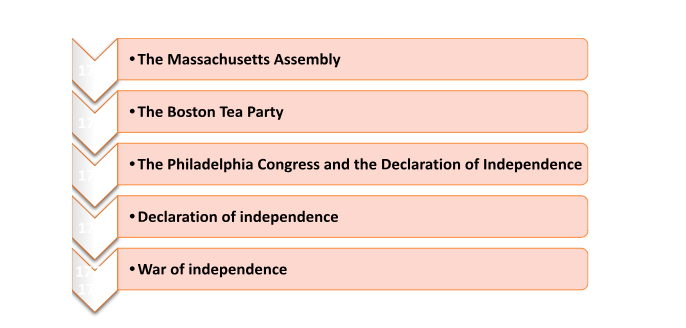
Important Events that marked the American Revolution
The Massachusetts Assembly of 1765
Leaders from all colonies gathered in the Massachusetts Assembly to discuss common issues.
They demanded "No taxation without representation" and threatened to boycott British goods.
The Stamp Act was repealed, but the British Parliament continued to tax consumer goods.
Colonists insisted that only their local assemblies had the right to impose taxes.
In protest, Americans significantly reduced their imports from England.
The English government retained the tax on tea to assert their taxing authority.
The Boston Tea Party of 1773
Colonists in Boston refused to unload tea from English ships.
Disguised as American Indians, protesters boarded the ships and dumped the tea.
This event, known as the Boston Tea Party, heightened tensions and led to the closure of the port by the British government.
Philadelphia Congress and Declaration of Independence (1776)
Delegates from all colonies (except Georgia) gathered in the first continental congress in Philadelphia (1774).
Congress appealed to the British king for industry and trade freedom, protested against taxation without consent, and organized military preparations.
The Second Continental Congress chose George Washington as commander-in-chief, and after British refusal, adopted the Declaration of Independence (1776), drafted by Thomas Jefferson.
Declaration of Independence (1776)
Affirmed equality of all men and emphasized that authority comes from the people.
Recognized people's right to establish their own government.
Shifted the focus from fighting for rights as Englishmen to fighting for independence as a nation.
Adopted in 1776, the Declaration of Independence marked a pivotal moment in the colonists' struggle for self-governance and freedom.
War of Independence (1775-1783)
The Declaration of Independence marked the start of the American War of Independence, lasting over six years with battles in all colonies.
The Battle of Saratoga in 1777 was a turning point, as British forces surrendered to the Americans.
France and Spain joined the conflict as allies of the Americans, strengthening their cause.
The war ended with the surrender of Lord Cornwallis at Yorktown in 1781.
The Treaty of Paris officially recognized the United States as an independent nation.
Significance of the American Revolution
First Independent Colonies: The American colonies were the first to achieve independence, making them a symbol of liberation from colonial rule.
Example: It inspired Latin America in their struggles for independence.
Establishment of a Democratic Republic: In 1789, the United States Constitution came into effect as the first written Republic Constitution.
Example: The first written constitution came into existence encouraging the tradition of constitutionalism.
Influence on Democratic Models: The American federation became a model for larger, diverse nations with multiple ethnic and religious groups.
Example: India, with its diverse demographics, adopted a federal system of government modelled after the United States.
Contributions to Ideas and Anti-Colonialism: The American Revolution contributed to the concepts of liberty, equality, fundamental rights, nationalism, and anti-colonialism.
Example: The inclusion of the Bill of Rights in the U.S. Constitution emphasized individual freedoms and protections.
Impact on World Events: The American Revolution was a revolution of ideas and political systems influencing future events.
Example: The French Revolution in 1789, revolutions in Spanish and Portuguese colonies were inspired by the ideas of the American Revolution.
Emergence as a Global Player: Following liberation, the United States emerged as a powerful nation, playing a decisive role in world history for over 150 years.
Example: The United States' involvement in both World Wars and its subsequent superpower status solidified its impact on world affairs.
Causes for the American Revolution
Economic Causes
Restrictive trade policies: prevented the colonies from developing their own economy.
Example: Ironworks and textiles had to be imported from England
Trade Restrictions: Colonies were forbidden from using non-British ships in trade using the Navigation Acts. Certain products could only be exported to England, limiting trade opportunities.
Example: Tobacco, cotton and sugar could be exported only to England.
Taxation without Representation: The American colonists resented the imposition of various taxes by the British Parliament, without granting them representation in the legislative process.
Example: The imposition of The Stamp Act and the Townshend Acts
Political Causes
Lack of Self-Government: The colonists felt their political rights were being curtailed by the British government, as they had limited control over their own affairs.
Example: The Stamp Act in 1765 directly restricted the colonists' ability to conduct their own business and manage their affairs.
Grievances against British Rule: The colonists opposed British policies.
Example: Acts like the Quartering Act, which required them to house and feed British soldiers and the Proclamation of 1763, which limited westward expansion.
Military Conflict: It propelled the colonists' fight for independence.
Example: Britain's decision to recover the expenses of the Seven Year War by imposing taxes on the people in their North American colonies was met with opposition from the colonists.
Social Causes
Class interest favoured Revolution.
Example: Merchants favoured revolution in the hope of economic freedom, and political leaders advocated for revolution as they could manifest their bright future in independent America.
Enlightenment Ideas: The revolutionaries drew inspiration from French and English philosophers such as Locke, Harrington, and Milton, who advocated for fundamental rights.
Example: Thomas Jefferson was influenced by French philosophers and asserted the colonists' right to rebel.
Factors contributed to the triumph of the American Revolution
Underestimation by the British: The British authorities initially overlooked the revolutionary efforts of the Americans and relied heavily on mercenary soldiers to suppress them.
Geographic Advantage: The remoteness of the American continent and the British authorities' lack of knowledge of American geography worked in favour of the Americans.
Example: Americans used guerrilla tactics and their knowledge of the local landscape to launch surprise attacks.
Failure to Rally Loyalists: The British authorities struggled to gather support from loyalist Americans, weakening their position.
Spirit of Liberty: The strong desire for liberty among the American revolutionaries fuelled their determination and contributed to their success.
Example: Thomas Paine's "Common Sense" in 1776 helped galvanize public support for independence and motivated many to join the cause.
Leadership: The extraordinary military leadership of George Washington played a crucial role in the American success in the war.
International Support: The international situation worked in favour of the American revolutionaries, with countries like France providing support after forming alliances and declaring war against England.
Example: The Treaty of Alliance was signed between the United States and France in 1778.
Impact of the American Revolution on India
Freedom Struggle
Inspiration for Independence Movements: It served as a catalyst for demanding rights from colonialists in future movements.
Example: Like the Boston Tea Party, Gandhi’s salt march played the role of awakening the British authorities to take seriously the demands of Indian nationalists.
Awakening of national consciousness: The success of the American Revolution showcased the possibility of overthrowing colonial rule and ignited a sense of national consciousness among Indians.
Example: It inspired Indian intellectuals and activists to assert their cultural identity and demand self-rule.
Ideological impact
Influence on Political Thought: Ideas of liberty, equality, and self-governance influenced Indian political thinkers
Example: Concepts like fundamental rights and representative government shaped their vision for a free India.
Role in International Diplomacy: The American success encouraged other countries to consider recognizing and forming alliances with emerging nations seeking independence.
Example: The American Revolution's success encouraged India to engage in international diplomacy.
Influence on Indian Constitution:
Democratic Principles: Ideas of liberty, equality, and consent of the governed influenced the drafting of the Indian Constitution.
Bill of Rights: Fundamental Rights and Individual Liberties were influenced by the Bill of Rights.
Sovereignty: The American Revolution's assertion of power residing with the people influenced the concept of popular sovereignty in the Indian Constitution.
Separation of Powers: The Indian Constitution ensures checks and balances through the separation of executive, legislative, and judicial powers.
Federal Structure: The American Revolution's experience with federalism inspired the adoption of a federal structure in the Indian Constitution.
The American Revolution, driven by ideals of liberty and independence, ultimately led to the birth of a new nation and the establishment of democratic principles that shaped the course of history. Through armed struggle and unwavering determination, the colonists successfully severed ties with Britain, igniting a transformative era of self-governance and inspiring future revolutions worldwide.
Tags:
History & Culture
Keywords:
AMERICAN REVOLUTION
Important Events that marked the American Revolution
The Massachusetts Assembly of 1765
No taxation without representation
stamp act
The Boston Tea Party of 1773
Philadelphia Congress
Declaration of Independence
first continental congress in Philadelphia
George Washington
Thomas Jefferson
American War of Independence
Battle of Saratoga in 1777
Treaty of Paris
Significance of the American Revolution
first written constitution
federal system of government
An
Syllabus:
General Studies Paper 1
Topics:
World History
Related Articles
Backgrounder
HYPOTHETICAL IMPACTS ON MODERN INDIAN HISTORY IF KEY EVENTS DID NOT HAPPEN
Gandhism vs. Moderates
Satyagrahis vs. Revolutionaries
Moderates vs. Extremists
Sardar Vallabhai Patel and Jawaharlal Nehru
Gandhi and Rabindranath Tagore
Gandhi and Bhagat Singh
Gandhi and Subhash Chandra Bose
Gandhi and Ambedkar
Role of Foreigners in Indian Freedom Struggle