AMERICAN CIVIL WAR
Published on 05 Oct 2025
The American Civil War, fought from 1861 to 1865, was a conflict between the Northern states (Union) and the Southern states (Confederacy) over issues such as slavery, states' rights, and the preservation of the Union. It resulted in the abolition of slavery and the reunification of the United States.
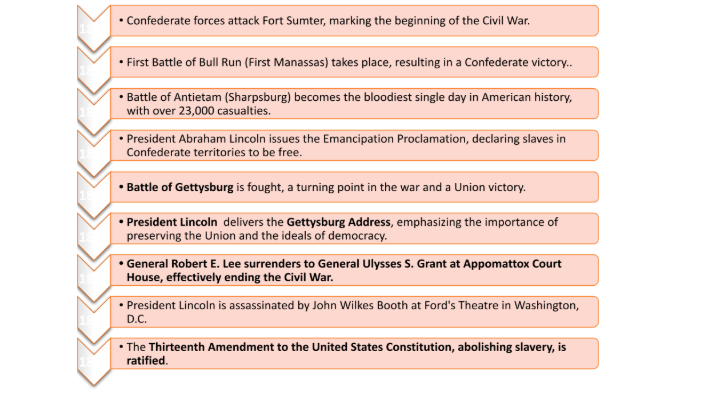
Key events of the American Civil War
Causes of the American Civil War
Slavery Issue: The North and the South were divided over slavery, with the South relying on it for labour while many in the North believed it was wrong.
Garrison published Liberator to support the anti-slavery movement.
Economic Issue: The industrialized North viewed slavery as incompatible with an industrial economy, while plantation agriculture in the South depended on slave labour.
Example: The North's growing industrial sector relied on free labour and faced competition from slave-produced goods.
Constitutional Issue: The debate over whether new states should be admitted as free or slave states intensified tensions.
Example: The Compromise of 1850, which allowed California to enter as a free state, sparked controversy and heightened sectional tensions.
Bleeding Kansas: The conflict over slavery erupted in Kansas as supporters from both sides fought over whether the territory would be a slave or free state.
Fear of Reforms by Abraham Lincoln: The election of Abraham Lincoln, who opposed slavery, heightened fears in the South.
Example: Lincoln's victory in the 1860 presidential election without even appearing on the ballot in many Southern states reinforced Southern concerns.
Immediate Causes: Lincoln's election and the secession of southern states served as immediate triggers for the Civil War.
Contribution of Abraham Lincoln
Leadership
Presidency: Elected as the 16th President of the USA in 1860, Lincoln led the nation during the Civil War, working to reunite the North and the South.
Abolition of slavery: Issued the Emancipation Proclamation, which declared slaves in rebellious Southern states to be freed, laying the groundwork for the eventual abolition of slavery.
Promoted capitalism: Removed obstacles to capitalism and contributed to America's rise as a major power
Mobilisation of masses: Mobilized volunteers and evoked patriotic emotions among Americans to support the cause.
Preservation of the Union: Lincoln transformed the war from a conflict over slavery into a fight to preserve the unity of the federation.
Direct Participation in Military Operations: Took part in key military decisions, including the capture of New Orleans and the Battle of Gettysburg.
Administrative Impact
Expansion of Federal Government: Expanded the role of the federal government in its efforts to maintain the Union and ensure its success during the war.
Passage of the 13th Amendment: Persuaded Congress to pass the 13th Amendment, which abolished slavery throughout the United States.
Advocate of Democracy
Reaffirmation of Democracy: Coined the famous principle of democracy "government of the people, by the people, and for the people."
Civil Liberties: After the Civil War, citizens of all states of the USA were granted citizenship and equal rights.
Significance of the American Civil War
Abolition of Slavery: The war led to the end of slavery in the United States with the passage of the 13th Amendment, freeing millions of enslaved African Americans.
Preservation of the Union: The Civil War ensured the permanence of the Union by abolishing the notion of states' secession.
Economic Growth: The war stimulated the growth of large-scale manufacturing industries, expanding the industrial base of the United States.
Territorial Expansion: The war resulted in the cultivation of more land, particularly in the western regions of North America, contributing to the expansion of the nation's territory.
Industrial Advancement: Increased use of machines and new weapons during the war boosted production and employment opportunities.
Financial Regulation: The war prompted the regulation of the banking system through the National Banking Act, which contributed to the growth of nationwide business.
Transportation and Communication Improvements: The war led to advancements in transportation and communication infrastructure, facilitating trade and national integration.
International Influence: The abolition of slavery in the United States inspired other nations to reconsider and eventually abolish the institution.
The American Civil War had a profound impact as it solidified the United States as a unified nation and contributed to the eventual decline of slavery as a global institution.
Tags:
History & Culture
Keywords:
AMERICAN CIVIL WAR
Northern states
Southern states
Confederacy
Key events of the American Civil War
battle of bull run
battle of manassas
battle of antietam
battle of sharpsburg
battle of Gettysburg
gettysburg address
Liberator
Kansas
Abraham Lincoln
Contribution of Abraham Lincoln
Abolition of slavery
Emancipation Proclamation
13th Amendment
United States
government of the people
by the people
and for the people
Robert E Lee
Ulysses S Grant
Syllabus:
General Studies Paper 1
Topics:
World History
Related Articles
Backgrounder
HYPOTHETICAL IMPACTS ON MODERN INDIAN HISTORY IF KEY EVENTS DID NOT HAPPEN
Gandhism vs. Moderates
Satyagrahis vs. Revolutionaries
Moderates vs. Extremists
Sardar Vallabhai Patel and Jawaharlal Nehru
Gandhi and Rabindranath Tagore
Gandhi and Bhagat Singh
Gandhi and Subhash Chandra Bose
Gandhi and Ambedkar
Role of Foreigners in Indian Freedom Struggle