NCSC NCST and NCBC
Published on 21 Jan 2025
National Commission for Scheduled Caste (NCSC), National Commission for Scheduled Tribes (NCST) and National Commission for Backward Caste (NCBC)
Article 338 and Article 338- A of the Constitution respectively provides for the office of National Commission for Scheduled Caste and National Commission for Scheduled Tribe. The National Commission on Backward Classes was formed as per the Mandal Commission judgment. Later the 102nd Constitutional Amendment inserted an Article 338-B giving constitutional backing to the body. All these bodies are considered as institutions aimed at securing social justice to the vulnerable communities of the society.
Significance of these offices
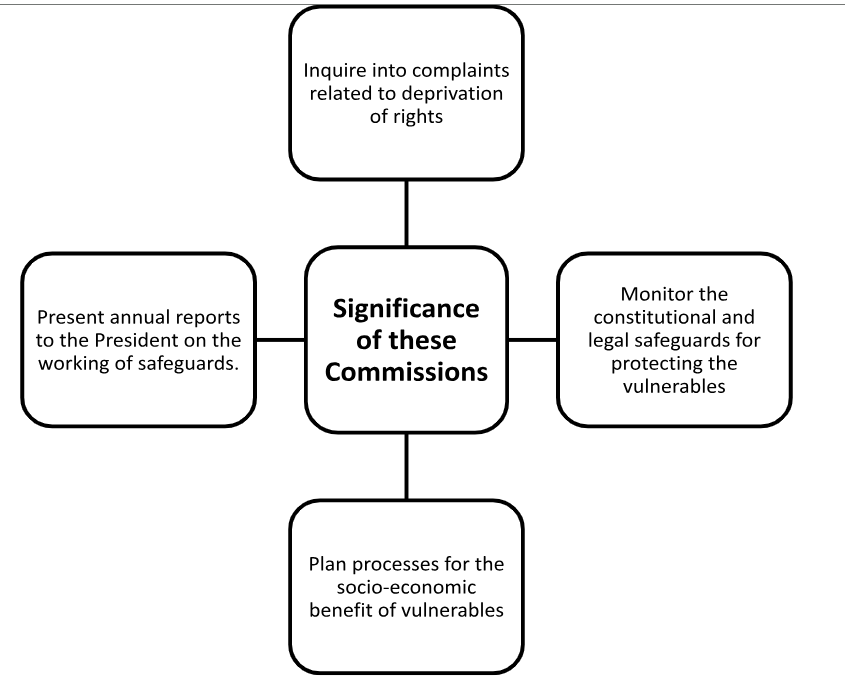
Issues associated with these offices
Less sensitive towards social issues: These commissions usually act on complaints and have only rarely exercised their suo motu power. But the probability of tribes or dalits registering such complaints is low.
Example: The NCST was not able to safeguard the tribal rights of Dongria Kondh community of Odisha who faced eviction due to the Vedanta project.
Non-binding recommendations: Little actions are being taken based on the recommendations made by the commission as these are not binding.
Example: The persistence of mob lynchings and honour killings indicate that the recommendations of the body has yielded little results.
Question regarding effectiveness: Even after decades of formation, the body has failed to bring any significant reduction in the level of atrocities faced by these social groups.
Example: Crimes against SCs went up 13% and against STs by 14.3% in 2022. (NCRB data)
Irregularity in reports: There have been instances where reports are not submitted in two or more years. Even when they are tabled in the Parliament, they are frequently not discussed.
Delay: Lack of financial and human resources has caused delay in conducting inquiry and in delivering judgements.
Example: Around 22000 cases are pending before the NCSC (Social Justice & Empowerment, 2015).
Way Forward
Strengthening the legal protection: Tighten the provisions under SC and ST Prevention of Atrocities Act to facilitate the commissions to punish the wrongdoers.
Promote online reporting and tracking of crime: This can increase the cases filed and improves the accountability of the commission.
More activists to be part of the Commission: Increased participation of social activists into the body can make them more sensitive to violation of rights and make them act proactively.
Devolve more resources: The shortage in finance and human resources must be bridged to reduce the delay in their functioning.
These institutions have a cardinal role to play in protecting the rights of socially vulnerable groups. Hence changes on the above-mentioned lines need to be made to make them powerful enough to exercise their functions.
Tags:
Polity
Keywords:
Constitutional bodies
NCSC
NCST
NCBC
Syllabus:
General Studies Paper 2
Topics:
Indian Constitution
Related Articles
Backgrounder
ELECTIONS - Types of elections
Terrorism in Kashmir
NORTH EAST INSURGENCY
MISSION KARMAYOGI
Civil Service Reforms and lateral entry
ROLE OF CIVIL SERVICE IN DEMOCRACY
SEVOTTAM MODEL
CITIZENS CHARTER
E-GOVERNANCE
CENTRALISED PUBLIC GRIEVANCE REDRESS AND MONITORING SYSTEM (CPGRAMS)