Central Administration Tribunal
Published on 28 Jan 2025
Central Administration Tribunal (CAT)
The Central Administrative Tribunal has been established under the provisions of Article 323-A of the Constitution to adjudicate disputes and complaints with respect to recruitment and conditions of service of persons appointed to public services.
Significance of Central Administrative Tribunal
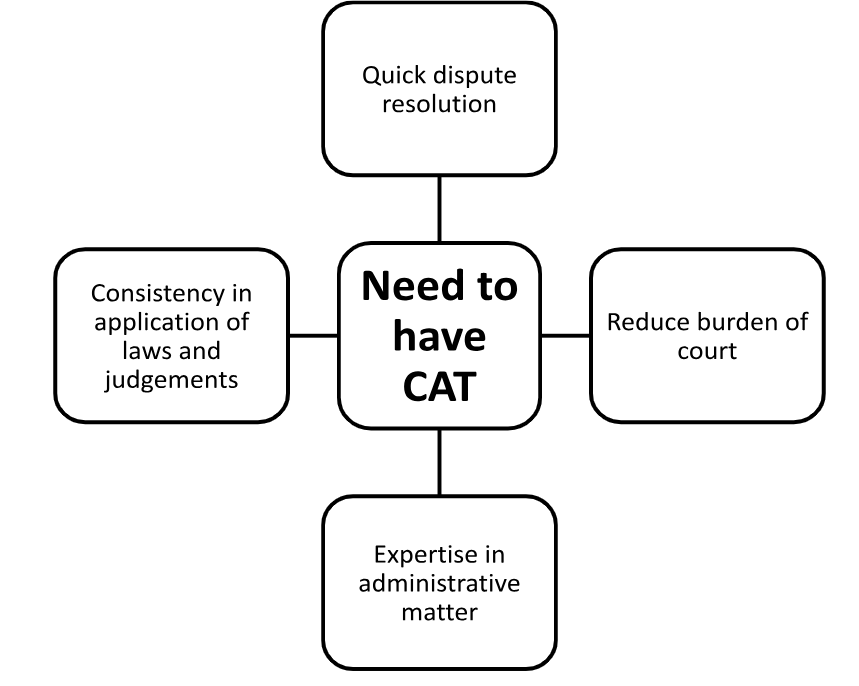
Issues associated with the office of Central Administrative Tribunal
Shortage of members: Vacancies at the office have been left unfilled reducing the manpower, creating unnecessary delay in disposing of cases.
Example: Supreme Court in 2022 had to invoke its extraordinary powers under Article 142 to allow CAT members to continue to function even beyond their term due to unfilled vacancies.
Limited accessibility: The absence of CAT benches in every state creates challenges for individuals who must travel significant distances to attend their case hearings.
Example: The tribunal has only 19 benches all over India.
Backlog of cases: Though CAT has fastened the process of dispute resolution, many cases are still pending at the tribunal.
Example: More than 80000 cases are pending across various benches of the tribunal. Around 1350 cases have been pending for more than 10 years. (Parliamentary data)
Lack of specialization in certain benches: Absence of expertise in specific administrative matters can compromise the quality of decisions and hinder tribunal’s effectiveness.
Appeal at High Court: The order of the CAT can be appealed at the High Court. Following this usual three tier system causes unnecessary delay.
Inadequate implementation of CAT orders: Instances where the orders passed by CAT being not effectively implemented by the concerned department questions the legitimacy of the tribunal.
Example: The Central government failed to absorb IPS officer Rajeshwar Singh in the Enforcement Directorate despite CAT’s order in 2014.
Way Forward
Permanent committee for appointment: This can reduce the delay in making recommendations for appointment. The Central government must also ensure that the recommended people are appointed with no delay.
Establish more benches: There must be benches in all states to improve accessibility.
Smooth functioning of the Central Administrative Tribunal is crucial for the effective governance of the nation. The government must promptly implement necessary reforms to ensure that the institution becomes more pertinent and dynamic.
Tags:
Polity
Keywords:
Central Administrative Tribunal
Constitutional bodies
Tribunals
Syllabus:
General Studies Paper 2
Topics:
Indian Constitution
Related Articles
Backgrounder
ELECTIONS - Types of elections
Terrorism in Kashmir
NORTH EAST INSURGENCY
MISSION KARMAYOGI
Civil Service Reforms and lateral entry
ROLE OF CIVIL SERVICE IN DEMOCRACY
SEVOTTAM MODEL
CITIZENS CHARTER
E-GOVERNANCE
CENTRALISED PUBLIC GRIEVANCE REDRESS AND MONITORING SYSTEM (CPGRAMS)