Women and Local Self Government
Published on 08 Jan 2025
Women and Local Self Government
The 73rd and 74th amendments make it mandatory for having 33% reservation for women in local government bodies. This has enabled to increase women participation in the political sphere with their count exceeding over 50% in local bodies of many states.
This has also improved governance as there has been better implementation of schemes and less corruption in women-led Panchayat. Women leadership has also strengthened government programmes like anti-liquor campaigns, anti-child marriage campaigns etc.
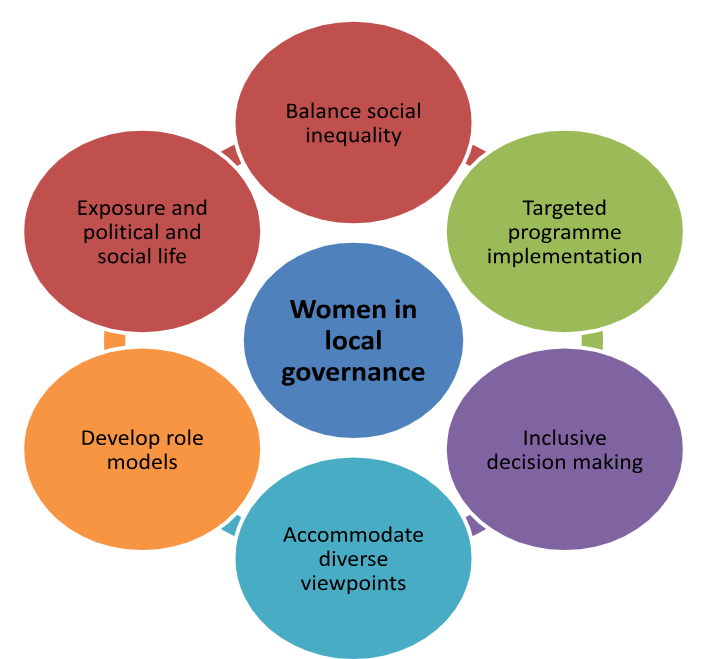
Need to promote women in local governance
Challenges to women participation in politics
Persisting patriarchal stereotypes: Deep-seated attitudes and gender stereotypes that often discourage women from pursuing a career in politics. This results in intimidation and even denial of orders coming from female representatives.
Example: As per Pew survey, 25% people in India still think men can be better political leaders than women.
Sarpanch Pathi practice: The reservation has been misused to seat wives/daughters of influential male figures, thus resting zero effective power with the female representatives.
Example: In Madhya Pradesh, male relatives of the elected female representatives took oath on their behalf.
Violence and cyber attacks: Targeted violence and efforts of character assassination can deter women from making political statements.
Example: As per reports of Amnesty International, Indian women politicians on average receive 113 problematic tweets per day.
Rotation policy in reservation: Since the reserved seats are being rotated, the representative gets only limited time to connect with the public and build a name for herself.
Work constraints: Limited political exposure and lack of training affect their performance. The mobile nature of the job also creates hindrance to their effective functioning.
Limited access to resources: Women have limited access to financial resources required for political campaigning.
Example: As per reports, the leading two or three candidates in a Panchayat election spend around 6 to 7 lakhs.
Way forward
Punchhi Commission recommendation: Fix the rotation of reservations to two terms so that they can have better connection with the public. Thus, they will have a better chance of winning even from an unreserved seat.
More women chairperson: The presence of a leader would make the female representatives more confident in exercising their powers.
Literacy and financial independence: Females can have independent viewpoints and make independent statements once they possess knowledge and social exposure.
More equitable spending during elections: Election funding and spending to be regulated better to ensure that economic positions have minimal influence on political outcomes.
Equitable distribution of political roles necessary for Indian polity and local government is the ideal tier to promote women's participation which will later reflect at the state and central level.
Tags:
Polity
Keywords:
Local self governance
Decentralization
women in local government
Syllabus:
General Studies Paper 2
Topics:
Governance and Transparency
Related Articles
Backgrounder
ELECTIONS - Types of elections
Terrorism in Kashmir
NORTH EAST INSURGENCY
MISSION KARMAYOGI
Civil Service Reforms and lateral entry
ROLE OF CIVIL SERVICE IN DEMOCRACY
SEVOTTAM MODEL
CITIZENS CHARTER
E-GOVERNANCE
CENTRALISED PUBLIC GRIEVANCE REDRESS AND MONITORING SYSTEM (CPGRAMS)