Tribunals
Published on 16 Jan 2025
Tribunals
A tribunal is a quasi-judicial dispute resolution institution that serves as an alternative to the traditional courts. The 42nd Constitutional Amendment introduced Articles 323A and 323B which dealt respectively with administrative tribunals and tribunals on other matters.
According to the Tribunal, Appellate Tribunals and Other Authorities Rules 2020, the appointment to the tribunals will be made by the Central government based on the recommendations of the Search and Selection committee. Only persons having judicial experience will be appointed and will have a fixed term of four years.
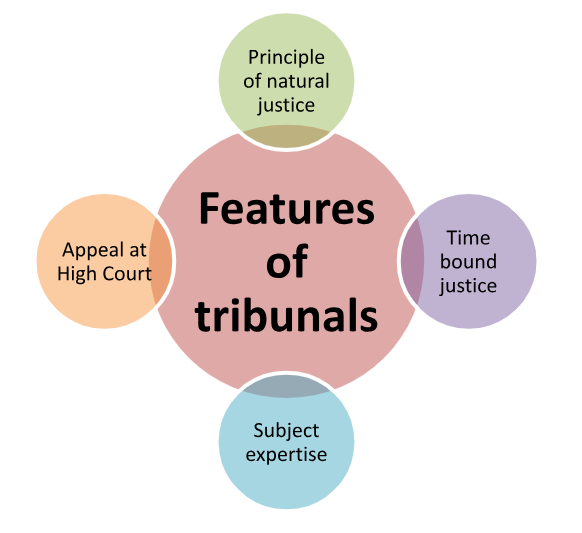
Features of tribunals
Challenges associated with the functioning of tribunals
Delay in justice delivery: Tribunals have been formed to speed up the cases that were pending before the judiciary. But there have been instances where cases are pending even at the tribunals.
Example: As per the 272 Law Commission report, the pendency for the Central Administrative Tribunal is 44333 cases.
Vacancies being unfilled: Many tribunals suffer from vacancies in the position of judges which results in a backlog of cases. This affects the timely delivery of justice.
Example: There are over 240 vacancies across various tribunals in India out of which 20 are for the post of Presiding officer.
Jurisdictional conflicts: There has often been conflict between regular courts and tribunals or between different tribunals over the jurisdiction of many cases.
Example: Overlapping jurisdiction of Competition Appellate Tribunal and National Company Law Appellate Tribunal.
Lack of expertise: As per new rules, only judicial members can be appointed as tribunal members who may not be experts in the particular tribunal’s domain.
Question of political interference: Since the appointment is made by the Central government, there have been concerns regarding the independence and transparent functioning of tribunals.
Example: Ministry of Finance is directly funding three tribunals associated with departments related to the Finance Ministry. This affects the independent functioning of tribunals
Limited accessibility: Some tribunals are located only in major cities making it difficult for litigants from remote areas to access them.
Example: National Green Tribunal has a principal bench in New Delhi and only 4 other benches which creates accessibility concerns.
Resource constraints: Infrastructure and human resource shortage has also plagued the growth of tribunals in India.
Way Forward
Transparent and faster appointment: Appointment should be made within a fixed time period to reduce case pendency and the appointment must be made with limited executive interference.
Improve accessibility: More regional benches shall be set up to make justice accessible to all.
Clarify jurisdictional conflicts: The jurisdiction of each tribunal must be well-defined to avoid confusion and future conflicts.
Enhance digitization: NGT has introduced e-filing and video conferencing to make proceedings more efficient.
Promote Alternative Dispute Resolution: Popularize measures like mediation and conciliation to reduce the cases being moved to tribunals.
Tribunals have aided in providing timely justice to the public and have reduced the caseload of the judiciary to some extent. But their efficiency needs to be improved by implementing some of the above-mentioned measures to bring more reliability and credibility to their functioning.
Tags:
Polity
Keywords:
Tribunals
Article 323A
Principle of natural justice
Syllabus:
General Studies Paper 2
Topics:
Indian Constitution
Related Articles
Backgrounder
ELECTIONS - Types of elections
Terrorism in Kashmir
NORTH EAST INSURGENCY
MISSION KARMAYOGI
Civil Service Reforms and lateral entry
ROLE OF CIVIL SERVICE IN DEMOCRACY
SEVOTTAM MODEL
CITIZENS CHARTER
E-GOVERNANCE
CENTRALISED PUBLIC GRIEVANCE REDRESS AND MONITORING SYSTEM (CPGRAMS)