Public Interest Litigation
Published on 16 Jan 2025
Public Interest Litigation
Public Interest Litigation (PIL) refers to litigation filed by a socially spirited individual to secure public interest. Though PIL has no statutory backing, the judiciary has used its powers under Article 142 to serve complete justice to entertain and decide upon such petitions.
The first case of PIL was the Hussainara Khatoon vs the State of Bihar where the court recognized the right to speedy justice as a basic fundamental right. The judgement given by P.N. Bhagawati in S.P. Gupta's case was instrumental in marking the beginning of the PIL movement in India.
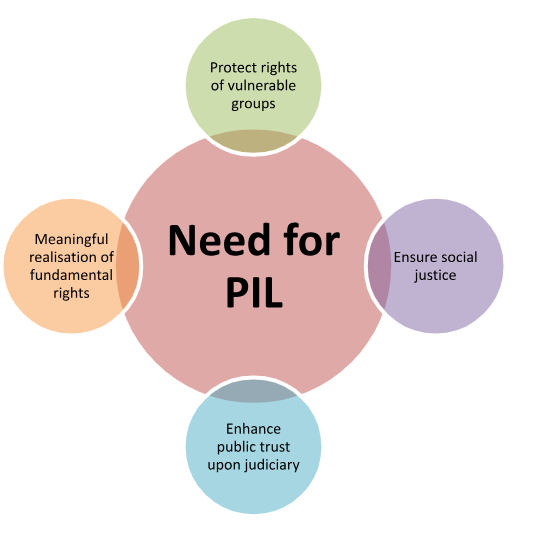
Significance of PIL
Issues concerning PIL
Rise in frivolous petitions: The increase in cases filed for personal or political gains with no public concern has undermined the credibility of PIL.
Example: Delhi High Court stated that PILs are now being used by publicity mongers while dismissing the plea against the appointment of Chandrachud as CJI.
Judicial overreach: The hike in PILs has made the judiciary more powerful than the branch often over-exerts itself, leading to judicial overreach.
Example: In 2017, a Judicial order requiring the playing of the national anthem at the cinema theatre was considered an act of judicial overreach.
Lack of Standing: Determining who has the legal standing to file a PIL has been a contentious issue.
Example: In the PUCL vs Union of India case, 2002, the Supreme Court held that a public-spirited individual could file a PIL, but this definition is considered too broad.
Judicial pendency: The Indian judiciary already has too many case backlogs. Unchecked PIL filings have increased the caseloads which hinder the timely delivery of justice.
Example: Over 9 lakh PILs have been filed between 1985 and 2020 at the Supreme Court.
Resource diversion: Unnecessary PILs force the courts to divert limited resources and time to such cases.
Media sensationalism: The publicity received for certain PILs creates pressure on the judges and they may give popular verdicts to avoid public criticism.
Way Forward
Clear guidelines: The judiciary must lay down clear provisions that define what constitutes a PIL to prevent misuse for personal or political gain.
Specialized benches: Establish special benches for handling PIL cases so that the high PIL petitions do not add to the already burdened judiciary.
Sanctions for frivolous PILs: Impose penalties on those who file malicious PILs to deter the abuse of the system.
Streamline procedure: Simplify and streamline PIL procedure by setting time limits for various stages of PILs such as filing, admissions and hearings to prevent delays
PILs are indeed necessary to open the doors of the judiciary to the weaker and poorer sections of society. Implementing some of these measures is the need of the hour to prevent the misuse of provision and to improve the functioning of PIL.
Tags:
Polity
Keywords:
Indian Judiciary
Judgements of SC
Public interest litigation
Article 142
Syllabus:
General Studies Paper 2
Topics:
Functions of Judiciary
Related Articles
Backgrounder
ELECTIONS - Types of elections
Terrorism in Kashmir
NORTH EAST INSURGENCY
MISSION KARMAYOGI
Civil Service Reforms and lateral entry
ROLE OF CIVIL SERVICE IN DEMOCRACY
SEVOTTAM MODEL
CITIZENS CHARTER
E-GOVERNANCE
CENTRALISED PUBLIC GRIEVANCE REDRESS AND MONITORING SYSTEM (CPGRAMS)