Judicial Accountability
Published on 20 Jan 2025
Judicial Accountability
The term Judicial Accountability means that the judges are responsible for the decisions they deliver and also be held accountable for their conduct. This has been a matter of debate as measures to enhance judicial accountability may infringe on the independence of the judicial system.
Elements of Judicial Accountability in India
Removal of judges: Article 124(4) and Article 217(1)(b) provide for the removal of Supreme and High Court judges on grounds of proven misbehaviour and incapacity.
Superintendence over subordinate court: Article 235 provides for the control of the High Court over the subordinate judiciary which is an effective mechanism to enforce accountability of the lower judiciary.
Values of Judicial Life Charter: The Supreme Court issued a Restatement of Values of Judicial Life Charter in 1997 which mentions the universally accepted norms, guidelines and conventions observed by judges.
Annual report: The Odisha High Court published an annual report of its performance in 2021 which gives a detailed view of the breakup of cases and reasons for the backlog of cases.
Online streaming: Live streaming of court proceedings has been implemented in the High Courts of Gujarat, Jharkhand, Karnataka etc. The Supreme Court has also constituted a subcommittee for framing Model Rules for live streaming.
RTI cover: Supreme Court ruling to bring the office of Chief Justice of India under the RTI legislation.
Need to enhance judicial accountability
Improve the quality of judgement: Accountability ensures that judges are more cautious about their judgement and give a verdict that serves justice better.
Example: Instances like the court asking the rapist to marry the victim can be reduced by making the judges accountable for such verdicts.
Impartial functioning: The court will act in an unbiased manner when there is public oversight. This augments public trust in the judiciary.
Example: The induction of Ranjan Gogoi into the Rajya Sabha after his retirement questioned the neutrality of the verdicts that he had delivered while being the Chief Justice of India.
Less obligation for transparency: Compared to the legislature and executive branch, the judiciary has more opaque functioning which is prone to misuse.
Example: There is no obligation to prepare an annual report and the ambit of RTI over the judiciary is too narrow.
Reduce the pendency: The backlog of cases has already reached a high and accountability can put more pressure on the judiciary to complete their cases on time.
Example: More than 5 crore cases are pending across all courts in India which can be reduced by proper accountability checks.
More transparency in appointments: The appointment and transfer policy has been alleged to be flawed and corrupt. Accountability provisions can make appointments more legitimate.
Example: Bringing collegium functioning under the mandate of RTI can make them more accountable for the appointments.
More clarity regarding in-house procedures: A better understanding of judicial proceedings can enhance public trust in the system.
Plug loopholes: Openly declaring the drawbacks aids in giving more focus to the weak areas and thus strengthening them through proper channelling of resources.
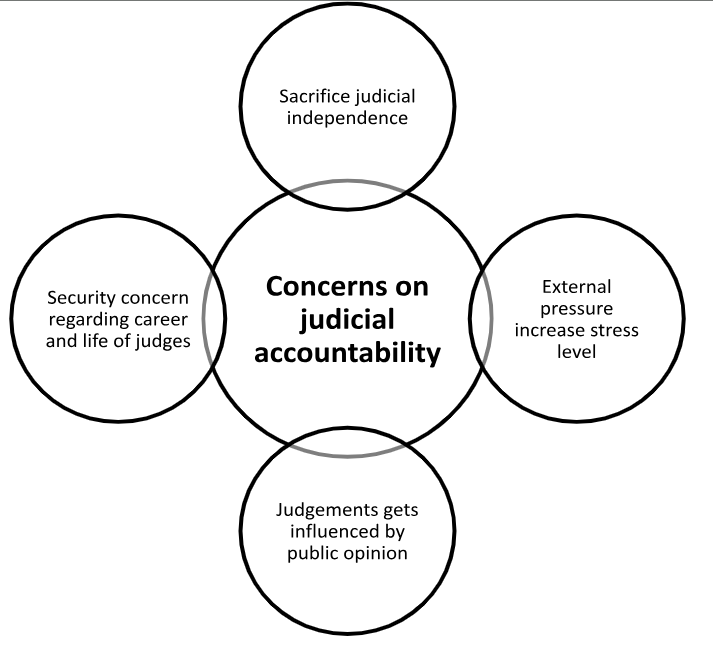
Challenges associated with enhancing judicial accountability
Way Forward
Oversighting body for ensuring judicial standards: A body having representation from both judiciary and executive to look into the conduct of judges and to ensure proper disposal of judicial standards.
Transparency to collegium: The proceedings of the collegium can be made more transparent by the preparation of writs.
Entertain more RTI: The Public should have a better understanding of the functioning of the judiciary by timely acceptance and disposal of PIL petitions.
Compliant mechanism: Robust and independent mechanism for lodging complaints against judges.
Protect whistle-blowers: Bring provisions to protect judicial officers who expose events of judicial misconduct.
Tags:
Polity
Keywords:
Judicial Accountability
Indian Judiciary
Challenges to Judiciary
Syllabus:
General Studies Paper 2
Topics:
Indian Constitution
Related Articles
Backgrounder
ELECTIONS - Types of elections
Terrorism in Kashmir
NORTH EAST INSURGENCY
MISSION KARMAYOGI
Civil Service Reforms and lateral entry
ROLE OF CIVIL SERVICE IN DEMOCRACY
SEVOTTAM MODEL
CITIZENS CHARTER
E-GOVERNANCE
CENTRALISED PUBLIC GRIEVANCE REDRESS AND MONITORING SYSTEM (CPGRAMS)