Indian Judiciary
Published on 15 Jan 2025
Indian Judiciary
India has an integrated pyramidal judicial system with the Supreme Court at the apex, the High Court at the next level, district and subordinate courts below them. India has a sound judicial system which has powers to balance the legislative and executive bodies by using the power of judicial review. The judiciary is the interpreter of constitutional provisions and legislations and is considered the ultimate guardian of the Constitution.
Independence of Indian Judiciary
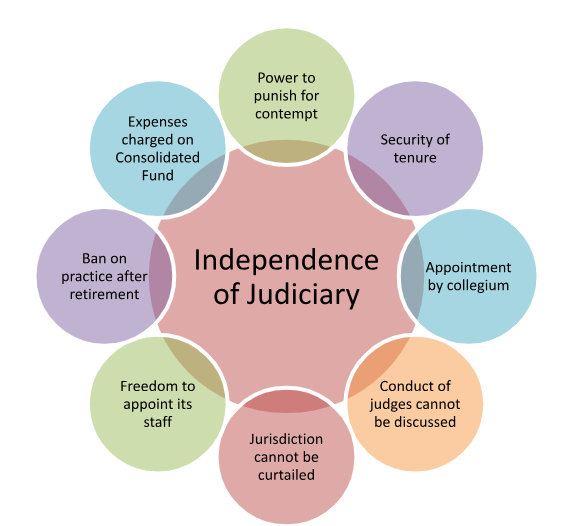
India has an independent judicial system with many features mentioned in the constitution which limits the powers of legislature and executives from interfering with the functioning of the judiciary. Some notable features indicating the independence of the judiciary are:
Challenges associated with the functioning of the Indian judiciary
Delay in justice delivery: The backlog of cases is so massive that the completion of a case consumes a lot of time. This delay reduces public trust in the judiciary.
Example: More than 5 crore cases have been pending across all courts in India.
Low manpower: Vacancy is high at all levels of the judicial system which results in delays in the completion of cases.
Example: In India, there are only 20 judges per million population while it is 50 to 70 judges per million in many European countries.
Lack of adequate infrastructure: Access to modern technology like digital access affects the efficiency of the courts.
Example: 27% of courts have no separate toilet for women while only 41% of court complexes have electronic video linkage facilities.
Opaque nature of the collegium system: The appointment and procedures followed by the collegium are not open to the public questioning the transparency behind their functioning.
Example: Allegations of nepotism in judicial appointments by prominent judges and government.
Judicial overreach: Excessive use of Article 142 has turned judicial activism into judicial overreach, interfering with the functioning of legislature and executive.
Example: Judicial order for banning the use of BS 4 vehicles has been regarded as a case of judicial overreach.
Corruption and ethical issues: There have been allegations of corruption within the judiciary which damages the reputation and integrity of the judicial system.
Misuse of contempt provision: The court sometimes shows zero tolerance and charges people for contempt for criticisms made on the judiciary.
Example: Contempt proceedings against Prashant Bhushan for criticism of the judiciary.
Way forward
All India Judicial Service: To ensure vacancies are filled without delay, especially at the subordinate court level.
Bring collegium functioning under RTI: There should be more accountability in the functioning of the collegium to reduce corruption in appointments.
Strengthen the E-court system: To reduce court processes, reduce paperwork and improve efficiency. Budget 2023-24 has allocated 7000 crore for the third phase of the e-court project.
Improve amenities: Solve basic cases through the metaverse technique, use blockchain to store data, improve court facilities through IT solutions etc.
Public legal education: Make people aware of their rights, make efforts to reduce unnecessary litigations and promote alternate dispute redressal mechanisms.
Though India has a strong independent judicial system, there exist many loopholes that hinder the proper functioning of the system. Adequate changes on the above-mentioned lines are necessary to ensure justice is delivered in a timely and effective manner so that public trust in the judiciary is protected.
Tags:
Polity
Keywords:
Indian Judiciary
Judgements of SC
Independence of Judiciary
challenges of judiciary
Syllabus:
General Studies Paper 2
Topics:
Indian Constitution
Related Articles
Backgrounder
ELECTIONS - Types of elections
Terrorism in Kashmir
NORTH EAST INSURGENCY
MISSION KARMAYOGI
Civil Service Reforms and lateral entry
ROLE OF CIVIL SERVICE IN DEMOCRACY
SEVOTTAM MODEL
CITIZENS CHARTER
E-GOVERNANCE
CENTRALISED PUBLIC GRIEVANCE REDRESS AND MONITORING SYSTEM (CPGRAMS)