Collegium System
Published on 16 Jan 2025
Collegium System
The Collegium represents an elite body comprising senior judges of the Supreme Court who recommend the names for appointments and transfers at the Supreme Court and High Court.
Evolution of Collegium System
The collegium system has evolved in India through various court judgements, popularly known as the Judges case.
First Judges case 1981: The court declared that the recommendations made by the Chief Justice of India regarding appointments can be refused by the government for cogent reasons.
Second Judges case 1993: The judgement equated consultation with concurrence and the government cannot reject the recommendation. The court also added that the CJI’s opinion alone was not sufficient, but an institutional opinion after consulting with two senior most judges in the Supreme Court must guide appointment.
Third Judges case 1998: Supreme Court expanded the Collegium to a five-member body comprising the CJI and four of his senior most colleagues.
National Judicial Appointment Commission Act, 2014 (NJAC Act): Since the collegium received too much criticism for its opaque functioning, the government introduced a body named NJAC through the 99th Constitutional Amendment. The NJAC, headed by the CJI, will have representation from both the judiciary and the executive. This body will replace the collegium and will make recommendations regarding judicial appointments.
Fourth Judges case 2015: The Supreme Court struck down the 99th amendment and labelled NJAC as unconstitutional as it violated judicial independence which is a part of basic structure doctrine. The collegium system was restored with all its powers.
Significance of the collegium system
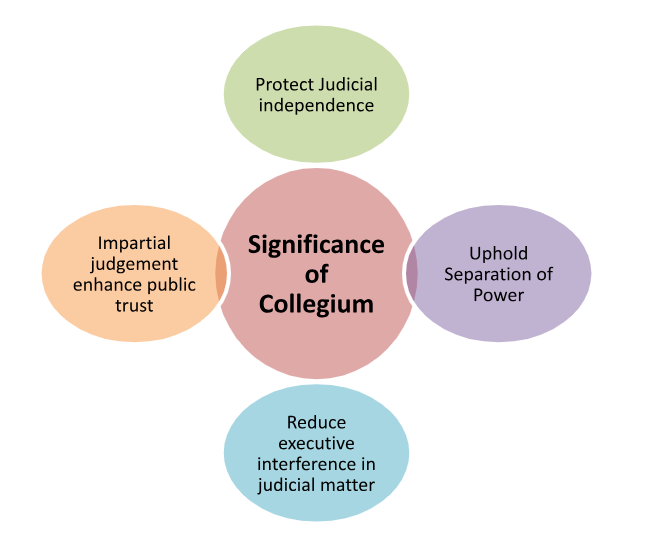
Issues concerning the collegium system
Lack of transparency: The collegium functions in a relatively secret manner with their procedures not being disclosed. The criteria for the selection and rejection of appointees are not disclosed which raises criticism.
Example: Controversy during the elevation of P.D. Dinakaran as the Supreme Court judge due to his connection with the former CJI K G Balakrishnan.
Lack of accountability: Since they function in secrecy, their actions cannot be held accountable. This lack of accountability has the potential to bring corruption.
Nepotism and Favouritism: There have been allegations of nepotism in judicial appointments recommended by the collegium.
Example: Allegations against Sharad Bobde’s appointment as Chief Justice as he belonged to an influential family with his father being Chief Justice of Bombay High Court.
Lack of diversity: The collegium lacks representation from women, minority caste groups etc which hinders inclusive decision-making.
Example: Only two women have ever been inducted into the Collegium.
Judicial superiority: The independence exerted by the collegium has made the judiciary superior to the other branches and has affected the balance of power between different branches.
Way Forward
Maintain transparency: Publish minutes of collegium meetings to provide insight into the decision-making process.
Standardized criteria: Develop clear standards for merit, seniority and diversity considerations.
Consultation and oversight: Involve a broad range of stakeholders, including legal experts and the bar association in the appointment process.
Feedback mechanism: For evaluating the performance of the judges, allowing for the removal or transfer of judges.
The Collegium system needs to have its levels of privacy to protect judicial independence but it shall degrade the institution into a corrupt body. Hence some changes on the above-mentioned lines could be made to make their functioning more efficient and trustworthy.
Tags:
Polity
Keywords:
Indian Judiciary
separation of power
collegium system
Three judges cases
Independance of judiciary
Syllabus:
General Studies Paper 2
Topics:
Functions of Judiciary
Related Articles
Backgrounder
ELECTIONS - Types of elections
Terrorism in Kashmir
NORTH EAST INSURGENCY
MISSION KARMAYOGI
Civil Service Reforms and lateral entry
ROLE OF CIVIL SERVICE IN DEMOCRACY
SEVOTTAM MODEL
CITIZENS CHARTER
E-GOVERNANCE
CENTRALISED PUBLIC GRIEVANCE REDRESS AND MONITORING SYSTEM (CPGRAMS)