INDIA MYANMAR RELATIONS
Published on 08 Jan 2025
India & Myanmar share a complex & delicate relationship arising out of the history of their interaction during the 19th & 20th centuries. It is rooted in shared historical, ethnic, cultural & religious ties.
Historical Ties
✔ Colonial Connection: India and Myanmar were both part of British India until 1935.
✔ Post-Independence Relations: After gaining independence, India and Myanmar established diplomatic ties and signed the Treaty of Friendship in 1951.
✔ 1987 Prime Ministerial Visit: A crucial visit in 1987 by the Indian Prime Minister laid the foundation for a stronger India-Myanmar relationship.
✔ Consulate Establishments (2002): In 2002, India reopened its Consulate in Mandalay, and Myanmar established its Consulate in Kolkata, enhancing bilateral engagement.
✔ Inclusion in India's Foreign Policy: Since 2014, Myanmar has been integral to India's foreign policy, aligning with the "Neighborhood First" and "Act East" policies.
Why is Myanmar important to India?
✔ Geopolitical
● Location: Myanmar shares a 1,624-kilometer land border with India.
● Gateway to Southeast Asia: Myanmar serves as India's gateway to Southeast Asia, positioning it as a pivotal player in India's regional connectivity.
o Example: IMT Trilateral highway being developed to connect India to Thailand via Myanmar
● Countering Chinese Influence: India, as part of its SAGAR Vision, invested in the development of the Sittwe port in Myanmar's Rakhine state to counterbalance China's influence
o Example: Kyaukpyu port project being developed by China.
● Border Security: Myanmar shares its border with some of India's northeastern states, which have experienced insurgent activities.
o Example: Local armed separatist factions operating within Myanmar's borders and Indian groups like ULFA in Assam and NSCN (IM) in Nagaland.
● Confluence of Foreign Policy Doctrines: Intersection of "Neighborhood First" and "Act East" Policies
✔ Economic
● Long-standing Economic Ties: India and Myanmar share a long history of economic cooperation, with India being one of Myanmar's significant trading partners.
● Investment across Sectors: India has made investments in multiple sectors within Myanmar, including energy, infrastructure, and agriculture, fostering economic development and bilateral relations.
Areas of Cooperation
✔ Political
● Multilateral Engagement: Myanmar is a key element in India's strategy to connect South and South-East Asia
o Example: Engagement through organizations like BIMSTEC, ASEAN, and Mekong Ganga Cooperation
✔ Economy
● Growing Bilateral Trade: Bilateral trade between India and Myanmar has surged from $12.4 million in 1980 to $1.76 billion in 2022 (Engineering Export Promotion Council of India).
o Example: The new rupee trade settlement mechanism will further boost trade.
● Investments: As of March 2023, India is the 11th largest foreign investor in Myanmar.
o Example: Companies like Essar, GAIL, and ONGC Videsh Ltd. have invested in Myanmar's energy sector.
● Connectivity: Several connectivity projects envisioned to improve logistics and transportation.
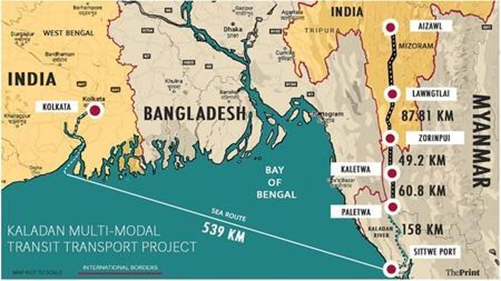
o Example: Indo-Myanmar Friendship Road (2001), Kaladan Multi-Modal Transit Transport, Asian Trilateral Highway
✔ Social
● Development Assistance: India has extended soft loans to meet Myanmar's essential needs.
o Example: India has extended $2 billion in soft loans to Myanmar, focusing on Myanmar's developmental priorities.
● Education and Research: India assists in setting up educational and research institutions in Myanmar
o Example: The Myanmar Institute of Information Technology.
● Humanitarian aid: India has provided humanitarian aid and relief to Myanmar.
o Example: India gave support after the cyclone 'Nargis' in 2008 and a severe earthquake in the Shan State in 2011, demonstrating strong bilateral relations.
● Indian Diaspora: There are varying estimates of 1.5-2.0 million people of Indian origin living and working in various parts of Myanmar.
✔ Security
● Bilateral Exercises: Both countries participate in military exercises to strengthen army relations.
o Example: India-Myanmar Bilateral Army Exercise (IMBAX)
● Counter-insurgency: Myanmar plays a crucial role in India's counter-insurgency efforts in its north-eastern states.
o Example: Operation Sunrise by Indian and Myanmar armies in 2019 targeting insurgent groups
✔ Cultural
● Cultural Diplomacy: Myanmar is significant to India's cultural diplomacy, particularly utilizing Buddhism as a focal point for promoting tourism.
o Example: India’s “Buddhist Circuit” initiative which connects ancient Buddhist heritage sites across different states in India resonates with Buddhist-majority Myanmar.
Challenges in India- Myanmar Relations
✔ Geopolitical
● Recent Military Coup: The military junta's recent coup in Myanmar has created a dilemma for India.
o Example: India needs to balance its strategic and economic interests with its commitment to democratic values and human rights.
● China Factor: China’s increasing footprint in Myanmar is a strategic challenge to India’s engagements with Myanmar as well as to its outreach to Southeast Asia.
o Example: China building a listening post on Myanmar’s Great Coco Island, which is just 55 km to the north of India’s Andaman and Nicobar Islands.
✔ Economic
● Weak Trade Relations: India's bilateral trade with Myanmar, approximately $2 billion, lags behind China.
o Example: The trade volume between the two countries for the year 2022-2023 (up to February) was around $8.4 billion, (Myanmar's Ministry of Commerce)
● Poor multilateralism: India not joining the Regional Comprehensive Economic Partnership (RCEP) could further widen this trade gap.
● Trust Deficit: Overtime trust deficit has widened between India-Myanmar because of the Indian reputation for delaying implementation of various projects.
o Example: Kaladan Multi-Modal Transit Transport Project got delayed and revised its deadlines many times.
✔ Security
● Rohingya Issue: The presence of Rohingya refugees in India raises concerns about internal security and the strain on national resources.
o Example: The arrival of Chin and Kuki refugees from Myanmar has caused resentment among the Meiteis and the Nagas
● Northeast Insurgency: The Myanmar-China border is a hotspot for armed separatist groups in Myanmar and Indian insurgent groups.
o Example: ULFA in Assam and NSCN (IM) in Nagaland.
● Porous Indo-Myanmar Border: The porous and lightly policed Indo-Myanmar border is exploited by terrorist organizations and insurgent groups.
o Example: Activities like supplying trained cadres and arms trafficking across borders.
● Free Movement Regime: The 16 km Free Movement Regime is exploited by militants and cross-border criminals
o Example: Using borders for illegal transportation of weapons, contraband goods, and counterfeit Indian currency.
Way Forward
✔ Swift Resolution of Rohingya Issue: A speedy resolution of the Rohingya issue will enable India to focus on bilateral and sub-regional economic cooperation with Myanmar and Bangladesh.
✔ Capitalizing on Myanmar's Emerging Market: Myanmar's 60 million population presents opportunities for exports in various sectors, from personal care to telecommunications.
✔ Boosting Connectivity: Accelerating projects like the India-Myanmar-Thailand Trilateral Highway and Kaladan Multi-Modal Transit Transport is crucial for improving connectivity
✔ Cultural Diplomacy: India's engagement in Buddhist diplomacy can enhance tourism and build goodwill with Buddhist-majority countries like Myanmar.
✔ Enhancing Security Cooperation: Improved security cooperation at the border is essential for strengthening economic ties between India and Myanmar.
✔ Effective Border Management: Both nations must collaborate on managing and regulating their open borders, addressing internal and external security challenges.
✔ Act East Policy and Myanmar's Role: Leveraging Myanmar's Gateway Status is pivotal to realizing India's Act East Policy.
✔ Diversifying Sectors: India can expand its presence in sectors such as manufacturing, cement, furniture, FMCG, energy, telecommunications, healthcare, infrastructure, and rural electrification in Myanmar.
✔ Collaborating with Japan: Strengthening collaboration with Japan, which has a growing presence in Myanmar, aligns with India's Act East Policy and Japan's Free and Open Indo-Pacific Strategy.
✔ Path of federal democracy: India reiterated its support to Myanmar for a transition towards a federal democracy.
India and Myanmar have the potential to foster mutually beneficial cooperation through enhanced diplomatic efforts, economic partnerships, and regional engagement, solidifying their strategic ties in the Indo-Pacific region.