WASH - Water, Sanitation and Hygiene
Published on 17 Feb 2025
As per WHO, 8,27,000 people in low and middle-income countries die as a result of inadequate water, sanitation and hygiene each year, representing 60% of total diarrhoeal deaths. Of these 4,32,000 people die because of diseases due to poor sanitation.
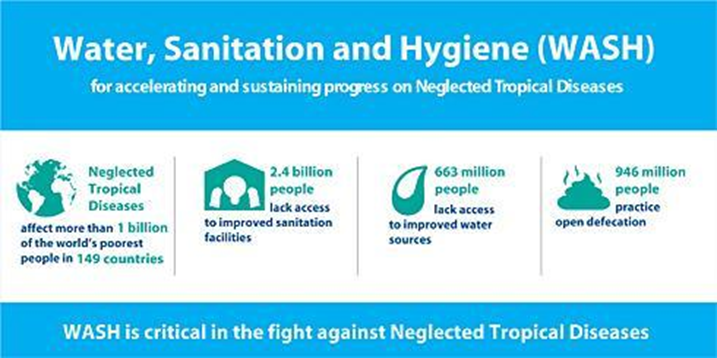
Significance of WASH in Indian context
✔ Public health: Access to clean water, proper sanitation and hygiene practices are fundamental to preventing waterborne diseases such as diarrhoea, cholera and typhoid.
● Example: As per a report by ASSOCHAM, waterborne diseases have an impact on over 3.77 crore Indians annually.
✔ Child health and education: Adequate WASH facilities in schools are essential for the health and well-being of students and also contribute to a healthier school environment.
● Example: According to MHRD data, only 47% of schools in India have access to drinking water and only 53% have separate toilets for girls and boys.
✔ Women’s empowerment: Lack of proper sanitation and clean water can lead to unhygienic practices, which may affect women's health and increase the risk of infections.
● Example: As per the Law minister’s Parliamentary speech, 26% of court complexes have no separate toilets for women.
✔ Rural development: Ensuring better water and sanitation supply is crucial for rural development, as it would improve the quality of life and standard of living of rural people.
● Example: As per the 2019 NSO survey, 25% of rural households lack access to sanitation services.
✔ Labour productivity: Workers who have access to clean water and sanitation facilities are more likely to stay healthy, leading to increased productivity and efficiency.
Challenges faced by India in improving its WASH standards
✔ Population density: Rapid urbanization and population growth have increased pressure on existing water and sanitation infrastructure, leading to inadequate service delivery.
● Example: As per data from the Economics and Statistics Department of Delhi, 44% of Delhi's slum residents depend on bottled water for drinking purposes and 28% of households use the flush-to-septic tank system.
✔ Poor sanitation infrastructure: Inadequate sanitation infrastructure, including a lack of sewage systems and waste treatment facilities, poses a challenge to improving the WASH standards.
● Example: 28.7% of rural households do not have access to toilet facilities while almost 4% of those households which have these facilities do not utilise them. (National Statistical Office (NSO))
✔ Water contamination: Industrial discharge, agricultural runoff and improper disposal of solid waste lead to water pollution, thus reducing access to safe drinking water.
● Example: In 491 districts in India, the water is contaminated by iron, while in 209 districts there is arsenic contamination.
✔ Lack of awareness: Many people, especially among the illiterate and the rural citizens, still have less concern towards improving sanitation standards and water quality.
● Example: The spread of e-toilets has been slow in India, due to a lack of awareness among the public on increasing the number of public toilets.
✔ Climate change impacts: Changing weather patterns and extreme climate events, such as floods and droughts affect water availability and quality and impact the sustainability of WASH initiatives.
● Example: Rainfall during August 2023 has been the lowest in the last century, which was 36% lower than the usual August rainfall, leading to a water deficit.
Way Forward
✔ Awareness: Conduct widespread awareness campaigns on the importance of hygiene, safe water practices and proper sanitation.
✔ End open defecation: Focus on eliminating open defecation through the construction of household toilets, community sanitation blocks and behaviour change campaigns.
✔ Water quality management: Establish robust monitoring and testing mechanisms to ensure the quality of water supplied and regularly test water sources for contamination and take corrective actions promptly.
✔ Climate resilient infrastructure: Develop and implement climate-resilient WASH infrastructure to mitigate the impact of climate change on water availability and quality and promote water conservation practices.
The Indian government is performing pretty well in addressing WASH challenges through the successful implementation of ongoing schemes like Swachh Bharat Abhiyan, Jal Jeevan Mission, Namami Gange Programme, AMRUT mission etc, with collaborative efforts from state government, local government and community participation.
Tags:
Social Sector
Keywords:
WASH
Water
Sanitation
SDG
Swachh Bharat Abhiyan
Jal Jeevan Mission
Syllabus:
General Studies Paper 2
Topics:
Social Justice
Related Articles
Backgrounder
E-cigarettes
Gender Budgeting
NGO and FCRA Amendment
Non-Governmental Organizations