INDIA RUSSIA RELATIONS
Published on 22 Jan 2025
Russia has been a long-standing friend and historical ally of India, providing essential defense equipment during critical periods. In 2010, both nations elevated their bilateral strategic partnership to a 'Special and Privileged Strategic Partnership,' emphasizing collaboration in political, security, defense, trade, economy, science, technology, and culture.
A Timeline of India-Russia Relations
✔ Soviet Era (Post-Independence - 1990s)
● 1950s-1980s: India's close relationship with the USSR facilitated its industrialization, with Soviet assistance in key areas like defense, space, and atomic energy.
● Dependence on USSR: During the Cold War and non-alignment decades, India depended on the USSR for support on strategic issues, including the Jammu and Kashmir problem.
● Indo-Soviet Friendship Treaty (1971): Strengthened the bilateral relationship, especially in military-technical cooperation.
✔ Post-Soviet Era (1990s - Early 2000s)
● 1990s: Following the disintegration of the USSR and Russia's economic challenges, India-Russia relations saw a decline.
● Criticism of India's Nuclear Testing (1998): Russian President Boris Yeltsin criticized India's nuclear tests, straining the relationship.
● Lukewarm Relations: The 1990s ended with lukewarm relations between the two nations.
✔ 21st Century (2000s Onward)
● Resurgence under Vladimir Putin: The 21st century witnessed a resurgence of India-Russia ties, particularly under Russian President Vladimir Putin.
● Reinvigorated Partnership: The relationship regained strength, with a focus on military, energy, and strategic cooperation.
● Annual Summits: India and Russia hold annual summits to enhance bilateral ties, with the leaders of both nations expressing commitment to the relationship.
Significance of Russia to India
✔ Role in India-China Relations: Russia's mediation capabilities can help balance India's relationship with China.
● Example: Trilateral meeting organized by Russia following Ladakh clashes.
✔ Diversification of Economic Engagement: Expanding economic ties into new sectors beyond traditional cooperation.
● Example: India's presence in the Russian Far East and collaboration in high technology.
✔ Combating Terrorism and International Diplomacy: Joint efforts in counter-terrorism, global diplomacy, and support for India's UN and NSG membership.
● Example: Advocating for the Comprehensive Convention on International Terrorism.
✔ Historical Arms Trade and Defense Cooperation: Russia's vital role in India's defense capabilities.
● Example: USD 35 billion arms imports from Russia in the past two decades.
Areas of Cooperation between India and Russia
✔ Political
● Strategic Partnership: The India-Russia Strategic Partnership, initiated in 2000 and elevated to a Special and Privileged Strategic Partnership in 2010, encompasses comprehensive collaboration in various fields.
o Example: The partnership includes diplomacy, defense cooperation, trade, and cultural exchanges, strengthening the bonds between the two nations.
● Counter-terrorism: Both India and Russia are committed to combat international terrorism, fostering global security and stability.
o Example: Joint efforts between the two countries have led to coordinated actions against terrorist threats and the sharing of intelligence for a safer world.
● UN reforms: India and Russia have advocated for the reform of the United Nations Security Council (UNSC) to ensure it reflects the contemporary global order.
o Example: In the 20th India-Russia annual summit in 2019, Russia expressed support for India's aspiration to become a permanent member of the UNSC.
● Support on Jammu and Kashmir Issue: Russia has supported India's stance on the Jammu and Kashmir issue, respecting India's sovereignty and constitutional decisions.
● Afghanistan Stability: Russia recognizes India's significant role in ensuring stability in Afghanistan and values India's involvement in the nation's long-term stability.
● International Forums: Both nations actively collaborate within international forums like the United Nations, Shanghai Cooperation Organization (SCO), BRICS, and G-20, working together on global challenges.
o Example: India's membership in the SCO, with Russia's endorsement, enhances India's regional influence and cooperation within the organization.
● Indo-Russian Inter-Governmental Commission (IRIGC): The IRIGC serves as an extensive mechanism for cooperation, focusing on trade, economics, science, technology, culture, and on military-technical collaboration.
o Example: Joint projects, such as the successful development of the Brahmos cruise missile, exemplify the effectiveness of the IRIGC in advancing military-technical partnerships.
✔ Energy Diplomacy
● Historical Collaboration: The former Soviet Union played a pivotal role in India's energy sector development, providing support for hydropower, coal, oil, and ONGC establishment.
● International Energy Cooperation: India and Russia extend their energy cooperation globally, including joint exploration and significant projects like LNG shipments.
o Example: The joint venture between Gazprom Group and India's GAIL for LNG shipments and plans for a Siberia-India pipeline illustrate international cooperation.
● Investments Abroad: India's substantial investments in the Sakhalin energy project in Russia mark its largest foreign investments in the energy sector.
● Collaboration in Maritime Territories: India and Russia explore potential cooperation in energy exploration in the maritime territories of countries like Bangladesh.
o Example: Joint involvement in the Rooppur Nuclear Power Plant project in Bangladesh showcases cross-border ventures.
● Nuclear Partnership: The Indo-Russian nuclear partnership bolsters confidence and enhances India's geopolitical influence.
o Example: Ongoing developments at the Kudankulam NPP and agreements for additional units underscore the deepening nuclear cooperation.
✔ Defense and Security
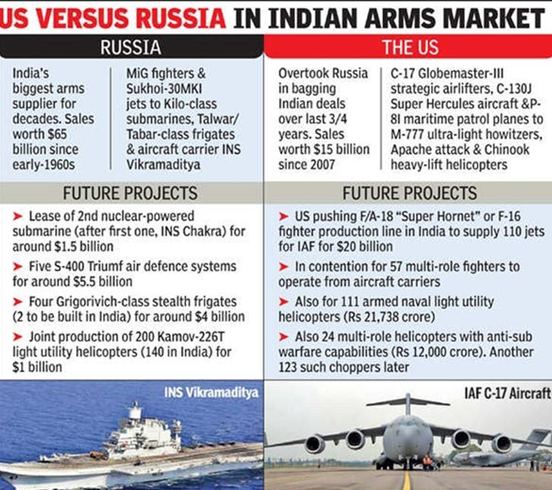
● Arms supplier: Russia continues to be India's largest arms supplier, even though its share of Indian defence imports fell from 62% to 45% between 2017-2022.
● Evolution of Military-Technical Cooperation: The defense relationship has transitioned from a buyer-seller model to one marked by joint research, development, and production of advanced defense technologies.
o Example: Collaborative programs like the BrahMos cruise missile, 5th generation fighter jet, Su-30MKI, and others exemplify this transformation.
● Military Exercise: Regularly conducted exercises demonstrate the combined military efforts and interoperability of Indian and Russian armed forces.
o Example: 'INDRA' exercises
● Joint Military Programs: The two nations engage in several joint military programs, encompassing advanced technology and hardware.
o Example: Collaborative projects include the BrahMos cruise missile program, development of 5th generation fighter jets, Su-30MKI aircraft, tactical transport aircraft, utility helicopters, and naval frigates.
● Acquisition of Military Hardware: India procures or leases various military equipment from Russia to strengthen its defense capabilities.
o Example: Key acquisitions involve the S-400 Triumf air defense system, Kamov Ka-226 helicopters manufactured under the 'Make in India' initiative, T-90S tanks, the INS Vikramaditya aircraft carrier, and more.
✔ Space
● Space Cooperation: Both India and Russia engage in joint activities focused on the peaceful utilization of outer space.
o Example: The MoU between ISRO and ROSCOSMOS for Human Spaceflight Programme and their continued cooperation in outer space activities highlight this collaboration.
● Science Academies: Science Academies of both countries promote exchanges and collaborations between scientists and researchers.
✔ Cultural
● Teaching Indian Languages: Approximately 20 Russian educational institutions, including universities and schools, regularly offer Hindi and other Indian languages to around 1500 Russian students.
o Example: The teaching of languages like Tamil, Marathi, Gujarati, Bengali, Urdu, Sanskrit, and Pali in Russian institutions fosters cultural exchange.
● Cultural Interests: Beyond language, the people of Russia have a deep appreciation for Indian culture, including dance, music, yoga, and Ayurveda.
✔ Economy
● Bilateral Investment and Trade: India and Russia have set ambitious targets to enhance bilateral investment to US$50 billion and bilateral trade to US$30 billion by 2025.
o Example: In FY 2020, the bilateral trade between the two countries amounted to USD 8.1 billion.
Challenges in India Russia relations
✔ China Factor
● Comprehensive Strategic Partnership: Unprecedented public closeness between Xi Jinping and Vladimir Putin.
o Example: Elevation of relations to a 'Comprehensive Strategic Partnership' for the first time.
● Economic Cooperation: Economic ties have become a cornerstone of the Russia-China relationship.
o Example: Rapid growth in China-Russia trade to $108 billion after Western sanctions.
● Shared Opposition to the West: Dissatisfaction with Western policies has driven Russia and China closer.
o Example: Western sanctions on Russia pushed it toward a closer partnership with China.
● Geopolitical Convergence: Alignment in supporting Syria and opposing US unilateral sanctions on Iran.
o Example: Joint use of veto powers in the UN to support Bashar al-Assad and Iran.
● Defense Cooperation: Russia's sale of advanced military technology to China.
o Example: Supply of S-400 systems and Su-35 fighter jets to China ahead of India.
✔ Geopolitical
● Russian Outreach to Taliban: Russia has been engaging the Taliban along with China to build influence in Afghanistan.
● Courting Pakistan: Russia appears to be enhancing its security ties with Pakistan, possibly influenced by India's growing proximity to the US.
o Example: Russia's involvement in China's Belt and Road Initiative, joint military exercises, arms sales, and energy projects with Pakistan.
● Challenges with the USA: Russia-US relations have deteriorated, partly due to conflicts in Ukraine, Syria, and allegations of Russian interference in US elections.
o Example: Imposition of CAATSA sanctions, which could impact India's relations with Russia.
● Wrinkles in Defense Cooperation: Challenges in India-Russia defense cooperation, such as diversifying defense acquisitions, maintenance issues, and stalled joint projects like the FGFA.
o Example: Termination of a bilateral defense program and doubts about the success of the Fifth Generation Fighter Aircraft (FGFA) project.
● Divergence on Indo-Pacific: India and Russia have differing views on the term 'Indo-Pacific' versus 'Asia-Pacific,' mainly due to Russia's close relationship with China.
|
Impact of the Ukraine War on the World
✔ Shortages of Essential Commodities: Disruptions in Ukraine's grain, edible oil, and fertilizer production and Russia's natural gas and crude oil exports have led to global shortages and price increases. ✔ Falling Stock Markets: Global stock markets have declined due to concerns about the economic fallout from the conflict. ✔ Public Discontent and Political Unrest: Rising prices and shortages of essential goods have triggered public protests and political instability in some countries. India, for instance, experienced unrest due to increasing fuel prices. ✔ Realignment of Global Alliances: The war has prompted countries to seek alternative sources for food, energy, commodities, and arms, resulting in shifts in global alliances and diplomatic relations. ✔ Economic Sanctions: The international community has imposed significant economic sanctions on Russia in response to its actions in Ukraine, severely impacting the Russian economy. ✔ Nuclear War Concerns: There is growing unease about the potential for a nuclear conflict, especially given the provocative nuclear rhetoric from President Putin during the Ukraine crisis.
India’s take on Russia-Ukraine War
✔ India has refrained from publicly criticizing Russia's actions despite mounting pressure from the US and its Western allies. ✔ India's abstentions on Ukraine-related votes at the United Nations Security Council and General Assembly stem from its longstanding defense and strategic ties with Russia. ✔ India's approach to the Russia-Ukraine crisis aligns with its historical stance during similar events, such as the Soviet interventions in Hungary (1956), Czechoslovakia (1968), and Afghanistan (1979). ✔ The crisis places India in a complex geopolitical position, straddling between Russia, a traditional politico-military partner, and the West, an emerging player in a multipolar world. India must re-evaluate its security and strategic challenges in light of this dynamic. ✔ India calls for a peaceful resolution to the situation through sustained diplomatic efforts, emphasizing the principles of an immediate cessation of violence, a return to dialogue and diplomacy, respect for international law and the UN Charter, and safeguarding the territorial integrity and sovereignty of all states. It also advocates unhindered humanitarian access to conflict areas. |
Way Forward
✔ Trade
● Pursue a Free Trade Agreement (FTA): Work on finalizing an FTA between India and the Eurasian Economic Union, which includes Russia.
● Fast-track the INSTC Project: Speed up the implementation of the International North South Transport Corridor (INSTC) to boost trade.
● Create a Green Corridor: Establish a system where selected companies or entrepreneurs in both nations can enjoy customs exemptions during border crossings.
● Diversify Trade Sectors: Broaden trade cooperation beyond traditional areas like defense, hydrocarbons, and nuclear power. Promote investment in sectors such as IT, pharmaceuticals, healthcare, defense manufacturing, infrastructure, and space technology.
● Boost Diamond Trade: Strengthen ties in the diamond sector to reach the goal of $30 billion in bilateral trade by 2025. Simplify tax and customs procedures for direct diamond trade.
● Invest in Russia's Far East: Continue investing in Russia's Far Eastern region and include it in India's 'Act East' policy to leverage its rich mineral resources.
● Facilitate Business Interaction: Establish a "Russia Plus" office in India and encourage Russian companies to invest. Promote collaboration through events like the India-Russia Business Summit for CEOs to discuss future partnerships.
✔ Military
● Timely Maintenance Support: Russia should ensure timely supply of spares and support to maintain Indian military equipment. The legislative changes and joint ventures outlined in the 2019 Inter-Governmental Agreement need to be promptly implemented.
● Mutual Acknowledgment: India and Russia should reaffirm their long-term defense partnership and recognize the importance of each other as strategic allies.
● Joint Military Production: The two nations should continue discussions on leveraging India as a production base for exporting Russian-origin equipment and services to third countries. This collaborative effort will strengthen their defense ties and enhance the defense manufacturing sector.
The future of India-Russia relations holds the potential to significantly influence global dynamics, as both nations seek to diversify their cooperation beyond traditional sectors and align on strategic economic and geopolitical goals. This partnership could enhance multipolarity in global politics and foster stability, impacting regional and international affairs in profound ways.