INDIA CHINA RELATIONS
Published on 22 Jan 2025
India-China relations are marked by intricate challenges, including border disputes and geopolitical competition. Yet, the sheer size and influence of both nations offer immense opportunities for cooperation and regional stability.
Areas of Cooperation
✔ Economy and Trade
● Trade Growth: China and India's trade has boomed in the 21st century, growing from less than $3 billion to over $100 billion.
o Example: In 2022, their trade volume reached around $136 billion. (annual customs data)
● Economic Potential: The combined market of over 2.7 billion people and a GDP accounting for 20% of the world's total creates significant economic potential for both countries.
✔ Science and Technology
● Collaborative Research: China and India actively participate in joint research workshops on science and technology.
● IT Corridors: Indian companies have established IT corridors in China to foster information technology cooperation. These corridors have led to joint innovations in high technology.
✔ Defense
● Anti-Terror Exercises: The "Hand-in-Hand" joint anti-terrorist exercises aim to enhance mutual trust and counter-terrorism capabilities.
● Defense Consultations: China and India engage in defense and security consultations, strengthening cooperation in areas such as military strategy and intelligence sharing.
✔ Social
● Cultural Mechanism: China and India hold meetings under the High-Level People-to-People and Cultural Exchanges Mechanism, promoting cooperation in various fields.
o Example: Indian Council for Cultural Relations (ICCR) offer scholarships for Chinese students to study in India
● Media and Think Tank Forums: The China-India High-Level Media Forum and Think Tank Forum facilitate media collaboration and policy research exchange.
o Example: They jointly organize international conferences.
● Sister Cities: Both countries have established sister city and province partnerships.
o Example: Fujian Province in China is twinned with Tamil Nadu State in India, fostering cultural ties and economic collaboration.
● Pilgrimage Growth: The number of Indian pilgrims visiting China's Xizang Autonomous Region has surged from hundreds in the 1980s to over 20,000 in 2019
Challenges in India-China relations
✔ Border Dispute
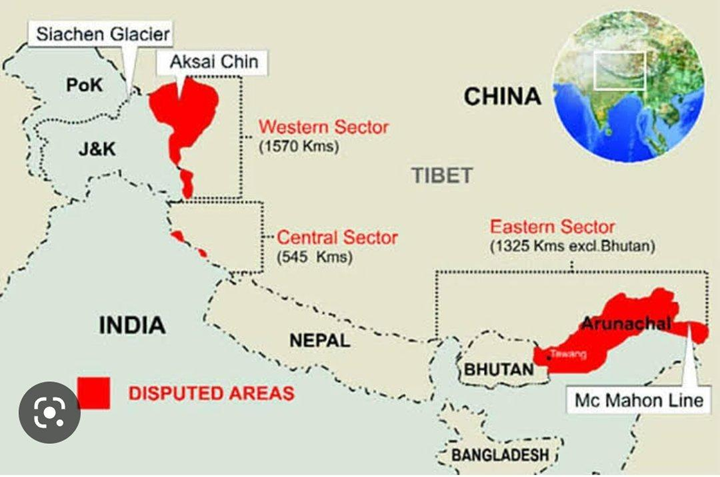
● Differing LAC Perceptions: India views the Line of Actual Control (LAC) as 3,488 km long, while China recognizes it as only around 2,000 km, leading to ongoing disputes.
● Western Sector Dispute: The conflict centers on India's claim that the Johnson Line marks the boundary, including Aksai Chin as part of India, while China accepts the MacDonald Line, designating Aksai Chin under its control.
● Eastern Sector Dispute: China claims Arunachal Pradesh which is a part of India as Southern Tibet.
● 2020 China-India Skirmishes: The 2020 Galwan clashes in Ladakh have increased hostility and eroded trust between the nations.
● Infrastructure Development: China has significantly improved infrastructure on its side of the LAC, prompting India to invest in its own infrastructure and subsequent rise in tensions.
● Erosion of Agreements: Agreements from the 1990s related to LAC maintenance are seen as increasingly unreliable.
✔ Economic
● Growing Trade Deficit: India's trade deficit with China has increased significantly.
o Example: For 2022-23 India's trade deficit increased to $83 billion, which accounts for 31.6 percent of India's total trade deficit. (Ministry of Commerce data)
● Market Impact: India faces challenges from the influx of lower-quality Chinese goods and non-tariff barriers on Indian products.
o Example: Restrictions on Indian pharma and IT exports have affected sectors vital to India's economy.
✔ Geopolitical
● Indo-Pacific Rivalry: Both India and China compete for geostrategic influence in the Indo-Pacific and South Asia.
o Example: China's naval assets in Hambantota, Gwadar, Kyaukpyu, etc., as part of its "String of Pearls" strategy, encroach on India's maritime interests.
● China's South Asian Influence: China's Belt and Road Initiative (BRI) and financial support to South Asian countries challenge India's regional position.
o Example: China has committed around 100 billion USD to the economies of Afghanistan, Bangladesh, the Maldives, Pakistan, Nepal, and Sri Lanka according to the American Enterprise Institute
● Dalai Lama: Chinese forces occupied Tibet in 1950, leading the Dalai Lama to seek refuge in India in 1959 which has strained India-China relations.
✔ China-Pakistan Nexus:
● Proxy Role of Pakistan: Pakistan is perceived as a proxy for China against India, serving as an instrument to contain India's influence.
o Example: Between 2017 and 2021, Beijing met 72% of Islamabad’s demand for major arms, (SIPRI data)
● Support for Terrorist Groups: China's blocking of UN action against Pakistan-based Jaish-e-Mohammad demonstrates its support for Pakistan's strategic interests.
● CPEC and Encirclement: The China-Pakistan Economic Corridor (CPEC) passing through Pakistan-occupied Kashmir (POK) aims to encircle India with the help of Pakistan.
● Shaksgam Valley issue: It is a part of Pakistan Occupied Kashmir (POK) and was ceded to China by Pakistan in 1963 when both countries signed a boundary agreement to settle their border differences.
● Iron brotherhood: It underscores their strong political, economic, and military ties, with both nations standing by each other on various regional and international issues.
o Example: China-Pakistan Economic Corridor (CPEC) to connect China's western region to Pakistan's Gwadar Port
● All-weather friendship: It highlights the consistent and enduring nature of their bilateral ties, which encompass cooperation in diverse fields such as defense, trade, and infrastructure development.
o Example: China's consistent support for Pakistan in international forums, particularly on issues related to Kashmir.
✔ Global Competition
● Differing Worldviews: India seeks a multipolar world order and collaborates with like-minded countries, while China aims for a bipolar world order with a unipolar Asia.
● Chinese Economic Influence: China leverages its economic clout and UN Security Council membership to counter India's rise globally.
o Example: China blocking India’s entry to Nuclear Suppliers Group (NSG), permanent seat in the United Nations Security Council (UNSC), etc.
✔ Water Hegemony
● Chinese Water Hegemony: China's plans to build super dams on the Brahmaputra River raise concerns about adverse effects on Indian regions, including flooding and water scarcity.
o Example: China's plans to build dams in Medgog county will affect people in North Eastern states.
● Weaponizing Water: The potential for China to weaponize water resources in the future adds to regional security concerns.
o Example: China stopped communication of water flow levels from its dams to Brahmaputra post the 2017 Doklam crisis leading to lack of adequate data to predict flooding in Assam.
● Seismic Vulnerability: Construction of super dams in the seismically sensitive Himalayan region may increase the vulnerability of the area to earthquakes.
Impact of Chinese aggression on India
✔ Potential Conflict: The aggressive border dispute between India and China, coupled with China's alignment with Pakistan, raises the specter of a full-scale war involving three nuclear-armed states.
✔ Trade Impact: Frequent disputes between India and China negatively impact their economic trade and business activities, which is detrimental to both nations' development.
✔ Economic Constraints: Due to economic limitations, significant increases in India's Defense Budget are challenging, necessitating a serious debate on capability building.
✔ Strategic Concerns: China's "String of Pearls" strategy, threatens to encircle India, diminishing its strategic influence and creating financial dependence on China.
✔ Energy Vulnerability: China's presence in the Indian Ocean could obstruct freedom of navigation, impacting India's oil imports. China's control of Pakistan's Gwadar Port could give it an advantage in disrupting India's energy supply during conflicts.
✔ Maritime Security: China's expanding maritime capabilities, including submarines and naval firepower, pose a security threat to India through control of sea routes in the region.
India’s Response to Chinese Aggression
✔ Indian Ocean Region (IOR)
● Project Mausam: A soft power diplomacy initiative by the Ministry of Culture aimed at revitalizing and fostering cultural connections among the Indian Ocean states.
● Sagarmala: A comprehensive project focused on the development of ports, infrastructure, and connectivity along the Indian Ocean coastline.
● Chabahar Ports and INSTC: Strategic endeavors to secure access to Central Asia while countering the influence of Pakistan and China in the region.
● India's Cotton Route Proposal: A proposal designed to strengthen ties among Indian Ocean Rim countries, promoting economic and cultural connections.
● QUAD and Malabar Exercise: Collaborative efforts involving India, Japan, the US, and Australia for regional stability and security, alongside joint naval exercises in the Indian Ocean.
● SAGAR Initiative: A framework known as "Security and Growth for All in the Region," emphasizing security and economic growth in the Indian Ocean region.
● Asia Africa Growth Corridor: A joint initiative by India and Japan to counter China's Belt and Road Initiative (BRI) by fostering economic development and connectivity in Asia and Africa.
● Act East Policy: Implementing the 'Act East Policy' to enhance engagement with ASEAN, South Korea, Japan, and others in China's neighbourhood.
● Naval assets: Modernizing India's naval power with assets like INS Arihant and INS Vikramaditya.
✔ Economic Measures
● Trade and procurement restrictions: The ban on 300 Chinese apps and increased scrutiny of Chinese investments are part of India's economic response.
● Exclusion: China may be excluded from certain sectors, including 5G trials, and road projects.
● Regulatory barriers: Implementing technical regulations and quality norms to reduce dependence on Chinese imports and address the trade deficit.
● FDI amendment: To prevent Chinese capital from taking over distressed businesses, India amended foreign direct investment (FDI) rules to mandate government approval for all investments from ‘border’ countries.
✔ Water Hegemony
● Hydropower project: India is considering building a 10 gigawatts (GW) hydropower project in the Dibang Valley in Arunachal Pradesh, to mitigate the adverse impact of the Chinese dam.
Way Forward
✔ Diplomatic Engagement: Initiate regular high-level diplomatic dialogues to discuss sensitive issues and foster trust.
✔ Crisis Communication: Establish a dedicated communication mechanism to manage and de-escalate border incidents promptly.
✔ Trade Normalization: Work toward reducing trade barriers and addressing trade imbalances through mutual agreements. Emphasizing the Make In India initiative to enhance manufacturing competitiveness.
✔ Leveraging the Service Sector: Despite import bans, India should negotiate for liberalized access to China's service sector, leveraging India's comparative advantage in services
✔ Cultural Diplomacy: Promote cultural exchanges, such as art exhibitions, festivals, and educational programs, to foster mutual understanding.
✔ Academic and Think Tank Cooperation: Facilitate collaboration between academic institutions and think tanks to generate ideas for improved relations.
✔ Cooperate in Regional Organizations: Collaborate within regional organizations like the Shanghai Cooperation Organization (SCO) to address common challenges.
✔ Engage in Multilateral Forums: Participate constructively in multilateral forums, such as the United Nations, to work together on global issues like climate change and healthcare.
✔ Border Mechanisms: Strengthen border management mechanisms to prevent misunderstandings and reduce the risk of conflicts.
✔ Track II Diplomacy: Encourage non-governmental organizations and civil society groups to facilitate dialogue and build bridges between the two nations.
✔ Supply Chain Resilience Initiative: Trilateral agreement between India, Japan and Australia to preserve regional order while balancing Chinese dominance to ensure more robust and diverse supply chains and integrate approaches to defense and security.
✔ Negotiating Water Management Agreement: Fostering cooperation through bilateral agreements to effectively manage shared water resources and mitigate potential conflicts.
✔ Reviving Panchsheel: Reinvigorating the principles of Panchsheel, focusing on mutual respect, non-interference, and peaceful coexistence, to guide diplomatic interactions and promote stability in the India-China relationship.
India has adopted a two-pronged competitive strategy towards China, which comprises internal efforts to strengthen its military, nuclear, space, and technological capabilities, along with infrastructure development. The latter is to enhance partnerships in India’s extended neighbourhood, as well as with like-minded major powers that can help balance China.