WOMEN'S ORGANISATIONS
Published on 30 Jan 2025
Importance of Women's Organisations
✔ Rights advocacy: Women's Organisations play a pivotal role in advocating for gender equality and women's rights.
● Example: The United Nations Entity for Gender Equality and the Empowerment of Women (UN Women) is the UN agency dedicated to gender equality
✔ Women's education: Education enhances women's confidence and ambition while cultivating awareness of their rights and empowering them to raise their voices against exploitation and violence.
● Example: Organisations like the Self-Employed Women's Association (SEWA) in India have empowered countless women by providing education and training.
✔ Economic Empowerment: Economic empowerment broadens women's access to resources, including jobs, financial services, property, skills, and market information.
● Example: Grameen Bank in Bangladesh provides financial independence to women, enabling entrepreneurship and poverty alleviation.
✔ Promoting women's health: Accessible healthcare enables women to study, work efficiently, and reach their full potential, fostering contributions to economic growth, social stability, and environmental sustainability.
● Example: Global Fund for Women caters to women's health needs worldwide.
✔ Political Representation: Increased women’s participation in politics can result in increased cooperation across party lines and more sustainable conflict resolution.
● Example: The 50-50 campaign in Zimbabwe, led by Women in Politics Support Unit (WiPSU), aims to achieve gender parity in political representation.
✔ Legal Support and Awareness: By providing support to women who have faced discrimination, violence, or injustice.
● Example: 'Legal Aid Society' in India offers legal aid and raises awareness about women's legal rights.
✔ Community Mobilisation: Women's Organisations engage in community mobilisation to address social issues.
● Example: Breakthrough Trust in India Targets youth, health workers, school staff, leaders, police and journalists.
✔ Gender-Based Violence Prevention: Women's Organisations aim at preventing assault, slavery, and emotional violence such as verbal abuse, confinement, sexual abuse etc.
● Example: Organisations like ‘Sayfty’ in India work toward creating awareness, preventing gender-based violence and encouraging survivors to speak out and seek justice.
✔ Skill Development and Employment: Skill development helps women to attain life skills leading to higher paying and good quality jobs, better livelihood, economic independence and the ability to earn for their families.
● Example: Women's Skill Development Program in Nigeria provides vocational training, enhancing employability and skills development among women.
✔ Intersectionality and Inclusivity: Women's Organisations emphasise intersectionality and inclusivity, recognizing diverse needs.
● Example: 'Black Women's Blueprint' in the U.S. focuses on issues intersecting race, gender, and socio-economic backgrounds.
✔ Policy Advocacy: Women's Organisations engage in policy advocacy, influencing governments to implement gender-sensitive policies.
● Example: The Beijing Declaration and Platform for Action was influenced by the collective efforts of women's Organisations globally.
✔ Global Solidarity and Collaboration: Women's Organisations foster global solidarity, collaborating across borders for a common cause.
● Example: The Women's March, demonstrates the power of global collaboration in advocating for gender equality and women's rights.
Types of Women’s Organisations
✔ Advocacy Organisations: Aims to promote and protect women's rights and interests, lobby policymakers, raise awareness of issues affecting women, challenge discriminatory practices, advance gender equality and empower women worldwide.
● Example: The International Federation of Women Lawyers (FIDA) is involved in promoting, protecting, and preserving the rights of women and children.
✔ Service organisation: Provide direct services to women, addressing their diverse needs and improving their lives such as healthcare, education, legal aid, and employment support.
● Example: The Young Women's Christian Association (YWCA) provides a wide range of services, including after-school programs, job training, and housing assistance.
✔ Professional organisation: Supports women in specific professions or industries, offering networking opportunities, mentorship, and advocacy for their advancement.
● Example: The Azad Foundation specifically works with resource-poor women living in urban areas in India.
✔ Community-Based organisation: Rooted in local communities and addresses the specific needs of women in their neighbourhoods providing a range of services, from literacy programs to childcare and economic empowerment initiatives.
● Example: ‘Swaniti’ assists in developing ideas and policies for the elected representatives and organises government programmes by working with rural women.
✔ Grassroots organisation: Formed by women themselves to address issues affecting their communities like environmental justice, reproductive rights, or immigrant rights.
● Example: Women’s Rehabilitation Centre worked in the Terai region of Nepal during the COVID-19 pandemic.
✔ Issue-Specific organisation: Focus on specific issues, such as violence against women, human trafficking, and women's economic empowerment.
● Example: SEWA –Self-Employed Women’s Association is a trade union that aims to organise women so that they can attain full employment and all its benefits.
Rise of Women’s Organisations and Movements in India
Women and women's movements have been active since the Vedic period and continued through the national movement era to the present times.
Women’s Movements Post 1947
Since the 1930s, women had been demanding the enactment of the Hindu Code Bill, a measure that Jawaharlal Nehru initiated in the early 1950s. Following independence, a committee chaired by B.R. Ambedkar, the law minister, submitted a bill that increased the age of consent and marriage, endorsed monogamy, granted women the rights to divorce, maintenance, and inheritance, and classified dowry as 'stridhan', or women's property.
Four separate acts were passed:
✔ The Hindu Marriage Act
✔ Hindu Succession Act
✔ Hindu Minority and Guardianship Act
✔ Hindu Adoption and Maintenance Act
Peasant Movements
✔ Women organised themselves on a separate platform of the Nari Bahini during the Tebhaga peasant movement in Bengal in 1946-47, running shelters and maintaining lines of communication. Communist women activists mobilised for women's rights to finances and property, fostering village-level Mahila Atma Raksha Samitis to tackle issues like domestic violence.
✔ Women played a significant role in the Communist peasant struggle in the Telangana region of Hyderabad State between 1946 and 1950, where leadership actively addressed women's concerns, including issues like spousal abuse.
✔ Communist women formed the National Federation of Indian Women in 1954.
Movements Post 1970
✔ Anti-price rise movement (1973-75): Orchestrated by women in Maharashtra's urban areas, numerous housewives participated in public rallies, while those unable to leave their homes showed support by beating thalis (metal plates) with lathas (rolling pin)
✔ Nav Nirman Movement: During the Nav Nirman movement, inspired by Jayaprakash Narayan's "Total Revolution”, the substantial participation of women proved empowering, fostering the self-assurance necessary to progress toward more intricate matters concerning patriarchy and women's oppression.
✔ Self-Employed Women’s Association: Established under the leadership of Ela Bhatt in Gujarat, as the women's wing within the Textile Labor Association (TLA), an established Gandhian organisation. This entity was distinctive for its organisation of women in the unorganised sector—such as vendors, hawkers, and those working from home in the putting-out system—into a union.
✔ Anti-Liquor Movements:
● Maharashtra (Dhulia district in 1972): This movement eventually transformed into a forceful anti-liquor campaign. Women, attributing liquor as the primary cause of spousal abuse, participated by shattering liquor pots in drinking establishments and publicly confronting men who abused their wives
● Uttarakhand (1960): Influenced by Gandhians like Vinoba Bhave, Sarla Behn and Mira Ben, Sunderlal Bahuguna etc. Women gathered in sizable numbers, protesting liquor vendors and advocating for the prohibition of alcohol sales
✔ Anti-Dowry Movements (After the Emergency period)
● Organisations like The Mahila Dakshata Samiti and The Janwadi Mahila Samiti took a pivotal role in initiating the anti-dowry campaign. Street rallies, theatrical performances, demonstrations outside victims' homes, and calls for legal reforms were prominent features of this movement.
✔ Anti-Rape Movements: Another critical issue that emerged was rape, particularly incidents involving police. The Rameeza Bee case(1978), the Mathura case (1980), and the Maya Tyagi case(1980) brought attention to this matter. Both women's organisations and mainstream political parties prioritized these concerns, leading to the introduction of a bill amending rape laws in 1980.
Environmental Movements
✔ Chipko Movement: In Uttarakhand, women played an active role in the Chipko movement that commenced in 1974. The movement, named for women embracing trees to prevent their felling by timber contractors, marked a significant environmental campaign. It highlighted the belief that women held a unique nurturing connection with nature and often bore the brunt of environmental degradation.
✔ Chhattisgarh Mines Shramik Sangh: Women actively participated in the movement established in 1977, protesting against the mechanisation policy of the Bhilai steel plant, which notably affected women's employment. This led to the emergence of the Mahila Mukti Morcha as a new platform.
✔ The Bhopal Gas Peedit Mahila Udyog Sangathan: It led the fight for justice for victims affected by the 1984 chemical gas leak at the Union Carbide factory in Bhopal.
Emergence of New Organisations And Movements
✔ Anti-Arrack Movement (1992-1996): Women in Andhra Pradesh protested against the widespread availability and consumption of arrack, a cheap and potent liquor that was causing widespread social and economic problems, including alcoholism, domestic violence, and poverty. The movement led to the prohibition of arrack in Andhra Pradesh in 1996.
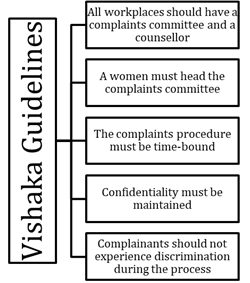
✔ Vishaka Guidelines (1997): In 1992, Bhanwari Devi, a social worker in Rajasthan, was ostracized and gang-raped by upper-caste men for trying to prevent child marriages. The Vishaka Committee was formed to investigate the case and recommend measures to prevent sexual harassment in the workplace.
● Note: The Vishaka Guidelines, issued in 1997, were the first comprehensive set of guidelines to address sexual harassment in the workplace in India. They have since been adopted by various organisations and institutions, and have helped to create a more just and equitable workplace for women.
✔ National Commission for Women (NCW) Act (1990): The NCW was established in 1990 as a statutory body to investigate and monitor matters relating to the constitutional and legal safeguards provided for women. It has conducted numerous investigations into issues such as violence against women, gender discrimination, and economic exploitation.
✔ Reservation for Women in Local Bodies (1993): The 73rd and 74th Constitutional Amendments of India reserved 33% of seats in panchayats (village councils) and municipalities for women. This reservation has led to a significant increase in the representation of women in local governance. It has also empowered women to participate in decision-making processes at the local level.
✔ Supreme Court Judgment on Dowry Deaths (1997): The Supreme Court of India issued a landmark judgement that made dowry deaths a crime under the Indian Penal Code. This judgement has helped to raise awareness of the issue of dowry deaths and has brought some perpetrators to justice.
The role played by Women's Organisations to Improve the Status of Women in Post-Independent India
✔ Promoting women’s rights: Women’s organisations at local and later national levels worked to end social evils against women, demand political rights and reform personal laws.
● Example: Shikshan Ane Samaj Kalyan Kendra was formed in 1980 to provide a sustainable way of life for women
✔ Providing support to victims: Women’s organizations have provided support to women who have been victims of domestic violence and sexual harassment.
● Example: Self-help groups like the Self-Employed Women's Association have conducted programs supporting victims of domestic violence.
✔ Empowering women: Women’s organisations have nurtured leaders of national stature who have forwarded social causes.
● Example: Medha Patkar in the Narmada Bachao Andolan.
✔ Demanding political rights: Women’s organisations have demanded political rights and reform of personal laws.
✔ Fighting Gender Inequality: Women’s organisations have spearheaded addressing issues like violence against women, gender equality, and justice.
● Example: Organisations like Snehalaya have significantly contributed to fighting gender inequality in India.
✔ Supporting Rural Women: Organisations like the Kasturba Memorial Trust and Bharatiya Grameen Mahila Sangh aim to empower rural women by nurturing their leadership potential.
✔ Addressing Women's Issues: Autonomous women’s organisations have taken proactive stances on concerns like dowry, domestic violence, workplace discrimination, sexual exploitation, crime, and violence against women.
✔ Creating Platforms for Women: Women’s organisations have offered platforms where women can unite, voice their concerns, and collaborate towards enhancing the status and well-being of women in India.
● Example: Pankhuri is an eminent online platform, where women who share similar interests in the fields of fashion, beauty etc collaborate for business.
Challenges Faced by Women's Organisations
✔ Lack of funding: Poor funding for their programs and initiatives, can limit their ability to make an impact.
● Example: The IANS report states that funding in women-led startups in India decreased from 183 startups in 2014 to a mere 7 in 2023.
✔ Lack of representation: Women’s organisations in India are dominated by upper-caste, urban, and educated women while marginalised women remain underrepresented.
✔ Lack of access to technology: Lack of digital skills, poor access to technology, and poor understanding of the digital domain limit these organisations' ability to reach a wider audience.
✔ Lack of legal protection: Limited legal protection makes it difficult for them to operate freely and without fear of persecution.
● Example: Human Rights Watch reports that women in India have limited legal protection, particularly in cases of domestic violence and sexual harassment.
✔ Social stigma: Women’s organisations in India face social stigma and backlash for advocating for women’s rights and challenging traditional gender roles.
● Example: ‘Global Voices’ report highlights that unmarried women in India face social stigma when it comes to accessing sexual health services.
✔ Lack of collaboration: Women’s organisations in India often work in isolation from one another limiting their ability to share resources and collaborate on initiatives.
✔ Political interference: Women’s organisations in India often face political interference, hampering their ability to operate independently and without fear of retribution.
● Example: A report by The Lowy Institute states that women in India’s major political parties are regularly sidelined and denied a party ticket to contest elections.
✔ Lack of recognition: Women’s organisations in India often struggle to gain recognition for their work, which can limit their ability to secure funding and support.
Role of Men in Women’s Organisations
✔ Support in Social Reforms: Figures like Raja Ram Mohan Roy actively supported women's organisations in India during the 19th century, advocating for social reforms such as widow remarriage and women's education.
✔ Leadership Roles: Leaders like Mahatma Gandhi supported and worked closely with women leaders such as Sarojini Naidu in the Indian National Congress, fostering their participation in the independence movement.
✔ Formation of Associations for Women's Causes: People like Jyotirao Phule played instrumental roles in establishing associations like Satyashodhak Samaj, which advocated for women's education and social equality in Maharashtra.
✔ Advocacy for Grassroots Initiatives: Individuals like Harish Iyer have actively supported grassroots movements addressing issues such as LGBTQ+ rights and gender equality, promoting inclusivity in Indian society.
✔ Support for Women's Empowerment Initiatives: Businessmen like Anand Mahindra have signed a memorandum of understanding with the Bill & Melinda Gates Foundation to support women's economic empowerment in India.
✔ Mentorship: People like N. R. Narayana Murthy, have played roles in mentoring and supporting women in the technology sector, fostering diversity and inclusion.
✔ Political Advocacy: Politicians like Shashi Tharoor have been vocal advocates for women's rights, participating in legislative discussions and promoting gender-inclusive policies.
✔ Media Representation: Journalists like Ravish Kumar have used their platforms to address issues related to gender-based violence, discrimination, and societal norms, contributing to awareness and discussions.
✔ NGO Leadership and Support: Male leaders, including Kailash Satyarthi, have been actively involved in NGOs advocating for women's and children's rights, addressing issues such as child trafficking and exploitation.
Role of Women in Women’s Organisations
✔ Founders: Women have been instrumental in founding and leading women's organisations, such as Annie Besant, who played a key role in establishing the All India Women's Conference (AIWC) in 1927.
✔ Social Reforms: Women leaders like Savitribai Phule and Pandita Ramabai were pioneers in advocating for women's education and social reforms during the 19th century.
✔ Participation in National Movement: Women like Sarojini Naidu and Kamala Nehru led the way, contributing to India's freedom struggle.
✔ Legal Reforms: Women leaders such as Dr Amrita Pritam were instrumental in advocating for legal reforms and policies, leading to significant changes in laws related to women's rights.
✔ Health Advocacy: Women's organisations, like the Self Employed Women's Association (SEWA) founded by Ela Bhatt, focus on healthcare initiatives, addressing the well-being of women in the informal sector.
✔ NGO Leadership: Organisations like M.V. Foundation by leaders like Shantha Sinha, have played key roles in addressing issues like child labour and education.
✔ Political Representation: Women leaders like Sushma Swaraj, have held significant political positions, influencing policies and advocating for women's issues.
✔ Economic Empowerment Initiatives: Organisations like the Women's Self-Employment Training Institutes (WSETIs), led by women like Neelam Chhiber, focus on economic empowerment through skill development.
✔ Community Mobilisation: Such as Medha Patkar's role in the Narmada Bachao Andolan, addressing environmental and social issues.
✔ Intersectionality Advocacy: Leaders like Kamla Bhasin contribute to feminist movements and intersectionality advocacy, promoting a holistic approach to gender equality.
Government Initiatives to Support Women and Women’s Organisations
✔ Women Entrepreneurship Platform (WEP): Initiated in 2017, WEP serves as a government-backed resource centre, streamlining support for women entrepreneurs in India. It effectively brings together diverse stakeholders to champion the cause of advancing women's entrepreneurship in the country.
✔ Stand-Up India: This government scheme aims to encourage entrepreneurship among women and marginalised communities like SC/ST groups. It offers loans ranging from Rs. 10 lakh to Rs. 1 crore to facilitate the establishment of new enterprises.
✔ Mahila e-Haat: An online marketing platform dedicated to supporting women entrepreneurs, self-help groups (SHGs), and NGOs, providing them with a digital marketplace to showcase and sell their products.
✔ Entrepreneurship and Skill Development Programme (ESSDP): This program focuses on delivering entrepreneurship and skill development training exclusively tailored for women.
✔ POSHAN Abhiyaan: A government initiative dedicated to enhancing the nutritional well-being of women and children across India.
✔ Pradhan Mantri Ujjwala Yojana: A scheme designed to offer clean cooking fuel specifically to women residing in rural areas.
✔ Swachh Bharat Mission: This nationwide initiative aims to elevate sanitation and hygiene standards in India, directly impacting the health and overall well-being of women.
✔ Mudra loan scheme: Geared towards promoting entrepreneurship, particularly among micro and small enterprises, this government initiative extends financial support. It places a special emphasis on empowering and fostering the growth of women entrepreneurs within the country.
Previous Year Questions (PYQs)
1. The women's movement in India has not addressed the issues of women of lower social strata. 'Substantiate your view. (2018)
2. Discuss the role of women in the freedom struggle especially during the Gandhian phase. (2016)
3. Women empowerment in India needs gender budgeting. What are the requirements and status of gender budgeting in the Indian context (2016)
4. Discuss the positive and negative effects of globalisation on women in India. (2015)
5. How do you explain the statistics that show that the sex ratio in Tribes in India is more favourable to women than the sex ratio among Scheduled Castes?
6. How does patriarchy impact the position of a middle-class working woman in India? (2014)
7. Discuss the various economic and socio-cultural forces that are driving the increasing feminisation of agriculture in India. (2014)
8. Why do some of the most prosperous regions of India have an adverse sex ratio for women? Give your arguments. (2014)
9. Male membership needs to be encouraged to make women's organisations free from gender bias. Comment. (2013)
10. Examine various initiatives taken by the Government of India to empower women in the society. Discuss recent happenings to justify your stand
11. The participation of women in the workforce in India is one of the lowest globally”. Comment and also suggest some measures to address this issue