Greenhouse Effect
Published on 06 Apr 2025
The greenhouse effect is the process through which heat is trapped near Earth's surface by substances known as 'greenhouse gases.' Greenhouse gases consist of carbon dioxide, methane, ozone, nitrous oxide, chlorofluorocarbons, and water vapor.
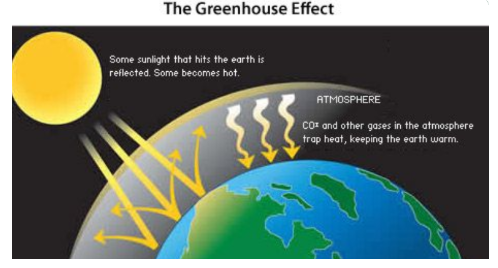
Causes of Greenhouse Effect
Burning of Fossil Fuels: Carbon dioxide (CO2) is released into the atmosphere in significant quantities when fossil fuels like coal, oil, and natural gas are burned to provide energy.
Example: According to UN, fossil fuels contribute to over 75 per cent of global greenhouse gas emissions and nearly 90 per cent of all carbon dioxide emissions.
Use of Fluorinated Gases: Hydrofluorocarbons (HFCs) and other synthetic greenhouse gases known as fluorinated gases are released by several industrial processes and products.
Example: Global fluorochemical production and use, including CFCs as well as other fluorinated chemicals, are responsible for the equivalent of approximately 870 million metric tons of CO2 per year
Deforestation: Forest clearing for agriculture, logging, and urban expansion limits the number of trees that can absorb and store CO2 through photosynthesis.
Example: Rapid urbanisation and large-scale deforestation have resulted in the release of 20KT CO2 and other GHG into the atmosphere every year in Guwahati.
Agricultural Practices: Agriculture releases nitrous oxide (N2O) and methane (CH4) into the atmosphere, which exacerbates the greenhouse effect.
Example: According to IAEA, agricultural activities contribute approximately 30 per cent of total greenhouse gas emissions, mainly due to the use of chemical fertilizers, pesticides and animal wastes.
Waste Management: Methane is produced during the anaerobic (low oxygen) decomposition of organic waste in landfills and waste treatment facilities.
Example: A report by Global Climate and Health Alliance says municipal solid waste contributes to 12 percent of global anthropogenic methane.
Impacts of Greenhouse Effect
Global Warming: Increased amounts of carbon dioxide, methane, and other GHGs trap more heat in the atmosphere, resulting to an overall warming of the Earth's surface temperatures.
Example: India’s emissions of carbon dioxide, methane and nitrous oxide from 1851-2021 have resulted in 0.04°C, 0.03°C and 0.006°C of global warming over pre-industrial levels, respectively.
Sea Level Rise: Warming temperatures contribute to glacier and ice cap melt, as well as saltwater thermal expansion.
Example: According to IITM Pune, Indian Ocean to witness a substantial rise of about 0.76 metres in the sea level due to GHG emission.
Ocean Acidification: Ocean acidification results from the world's seas absorbing more carbon dioxide from the atmosphere.
Example: According to oceanographers of MIT report, the pH of Northeast Pacific ocean is lowering because of anthropogenic emission of CO2.
Food Security: Crop yields and food production may be impacted by modifications to climatic patterns, such as variations in temperature and precipitation.
Example: 80% of smallholder famers could be affected by climate hazards such as drought, flooding, and extreme heat across India, Ethiopia and Mexico, according to McKinsey & Company report.
Shifts in Ecosystems and Biodiversity: Species experience difficulties adjusting to rapid changes in temperature, precipitation, and habitat conditions, resulting in shifts in species distribution and potential extinctions.
Example: A study found that 24.1 gigatons of CO2 emissions will decrease the number of polar bears that survive into adulthood by 2.7% in the Chukchi Sea subpopulation and by 0.6% in the West Hudson Bay subpopulation.
Extreme Weather Events: Extreme weather events are becoming more common and intense due to changes in the climate system brought on by greenhouse gas emissions. These include wildfires, hurricanes, floods, and droughts.
Example: 71% of the 504 extreme weather events and trends included in the map were found to be made more likely or more severe by human-caused climate change.
Government initiatives and policy measures
FAME India Scheme: It promotes electric and hybrid vehicles with the goal of lowering vehicle emissions and enhancing air quality.
National Solar Mission: To provide alternative for conventional energy source also reducing greenhouse gas emissions.
National Mission for Sustainable Agriculture (NMSA): Its main objectives are to advance climate-resilient farming, water-use efficiency, and sustainable agricultural methods.
Carbon watch: The app focuses on individuals’ activities and calculates carbon footprint on the basis of Transport, Energy, Waste and Water consumption.
International initiatives
Global Methane Pledge: Countries have pledged to cut methane emissions by 30% overall by 2030 compared to 2020 levels.
Renewable Energy Initiatives: It includes efforts such as the International Renewable Energy Agency (IRENA) and the Sustainable Energy for All (SEforALL) initiative.
Kyoto Protocol: It operationalises the UNFCCC by committing industrialized countries and economies in transition to limit and reduce greenhouse gases (GHG) emissions in accordance with agreed individual targets.
Way Forward
Implementation of Ambitious Climate Policies: Government should set up ambitious emission reduction targets, implement carbon pricing mechanisms, and promote sustainable practices across sectors.
Energy Efficiency Improvements: Improving energy efficiency in buildings organizations, transportation, and other areas is an affordable approach to lower greenhouse gas emissions.
Carbon Capture, Utilization, and Storage (CCUS): Adopting CCUS technology can assist in capturing and storing carbon dioxide emissions from power stations and industrial activities.
Protection and Restoration of Forests: Maintaining and improving the potential to sequester carbon requires protecting existing forests, stopping deforestation, and launching afforestation and replanting projects.
Circular Economy and Waste Reduction: Reducing, reusing, and recycling materials is the core of the circular economy, which can help reduce emissions related to waste management and resource extraction.
Case study
Zero-Emission Public Transportation in Bogotá, Columbia: The city launched an electric energy-powered Bus Rapid Transit (BRT) system investment. This helped to improve air quality, reduced emissions of greenhouse gases, and traffic congestion is decreased by the BRT system.
Tags:
Environment
Keywords:
Global warming
Greenhouse effect
Climate change
Carbon footprint
Syllabus:
General Studies Paper 3
Topics:
Environment and Climate Change
Related Articles
Backgrounder
Functions of an ecosystem
Principles of ecology
Ecological niche VS Habitat
Factors influencing ecosystem
Cloud Forest Assets
Sovereign Green Bonds
Sustainable cities integrated approach pilot (SCIAP) project
Sustainable Development Report 2023
Sponge City Concept
Jal Jeevan Mission